
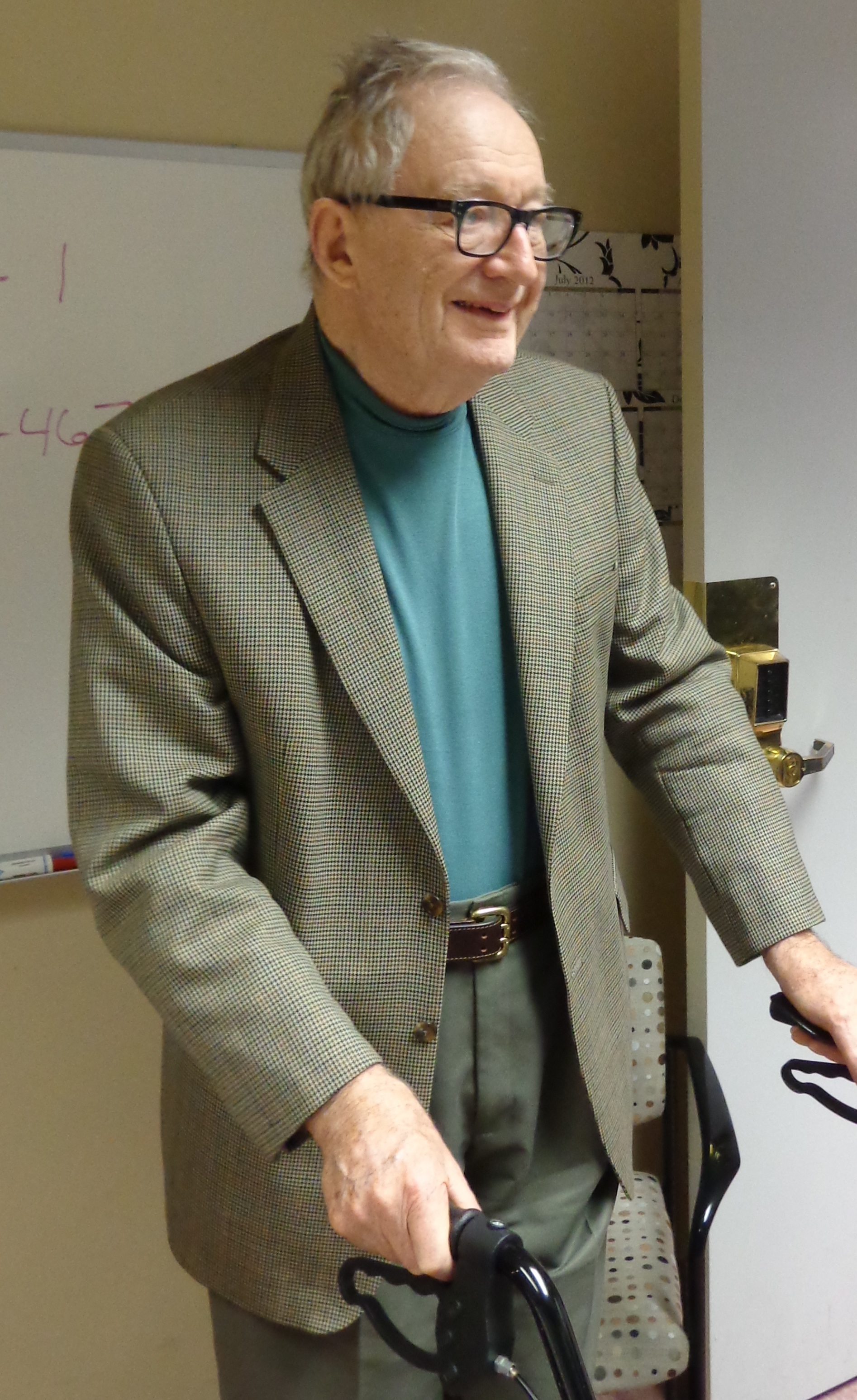
Dr. Norman Guthkelch at Medill
Photo by Sue Luttner
At 97, retired pediatric neurosurgeon Dr. Norman Guthkelch has ridden more than one wave of change in the practice of medicine.
He remembers that his mentor Sir Geoffrey Jefferson, Britain’s first professor of neurosurgery, cautioned his students against relying too heavily on x-rays, for example. Jefferson would warn, “The eye has rested upon the evidence of fracture, and the mind has traveled no further.”
“X-rays created a meaningless distinction between ‘fractured skull’ and ‘no fracture,'” Guthkelch explains, “whereas the important thing is the degree of damage to the underlying brain.”
Guthkelch’s medical training was interrupted by World War II: He went straight from his 1944 residency in Manchester into the army, and found himself neurosurgeon-in-charge of a small team attached to a general hospital. During the Battle of the Bulge, he was in surgery for 36 hours, breaking for food but not for sleep.
“That time gave me an advantage over surgeons with no battle experience,” he reflects. “I’d seen enough blood. Operating for its own sake was not an attraction.”
 After the war, Guthkelch returned to a fellowship under Jefferson, who had honed his own understanding of head injury during World War I. Relieved to be treating a general population, Guthkelch found himself especially charmed by his youngest patients, a delight noted by his mentor. “Jeff told me when I came back to finish off my training that my future lay in developing pediatric neurosurgery,” Guthkelch recalls. “He was quite right.” As Jefferson had held Britain’s first professorship in neurosurgery, Guthkelch in his turn received the nation’s first pediatric neurosurgery appointment, at the Royal Manchester Children’s Hospital. “It was only by a few weeks,” he chuckles, “but I was the first.”
One of his observations was that children in neurological distress were sometimes suffering the effects of subdural hematoma—that is, blood underneath the dura mater, the tough but flexible membrane that lines the interior of the skull. A subdural hematoma does not invade the brain, but it can exert dangerous pressure on the tissues below. And while a pool of subdural blood may dissolve on its own, it may also expand, causing further problems.
Guthkelch published his first paper on pediatric subdural hematoma in 1953, when he wrote in the British Medical Journal:
“It should be emphasized that infantile subdural effusion is not a rare condition. Study of the records of the Royal Manchester Children’s Hospital for the four years covered by this series shows that, of all surgical conditions of the central nervous system occurring in the first two years of life, only spina bifida and hydrocephalus were seen more often than subdural haematoma… Similarly, Smith and her co-workers (1951) have reported finding subdural effusions in almost a half of their cases of bacterial meningitis in infancy, and Everley Jones’s (1952) figures are similar.”
At that time, before CAT scans or MRIs, doctors inferred the presence of subdurals in living patients from the symptoms: convulsions, vomiting, and headaches in adults or fussiness in babies. The only way to confirm a subdural hematoma was to penetrate the subdural space. With an infant, the surgeon could pass a needle between the unfused plates of the immature skull. A problematic pool could then be drained, slowly, over several days to avoid a sudden change in pressure. In his 1953 paper Guthkelch described the procedure developed by pioneering pediatric neurosurgeon Franc Ingreham at the Children’s Hospital Boston, and reported on his own findings while treating 24 cases.
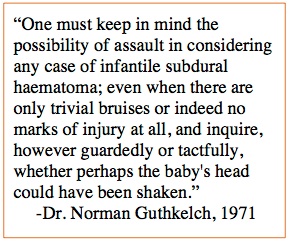 The paper that brought Guthkelch into the child abuse arena is the advice he offered in the British Medical Journal in 1971, under the title, “Infantile Subdural Haematoma and Its Relationship to Whiplash Injury.” At that time in Britain, Guthkelch says, shaking a child in the course of discipline, “or not even discipline, correction, shall we say,” was considered acceptable. He recommended that health workers discourage the habit, as it was causing damage to developing brains. He cited cases in which parents had told him of shaking their child, and he referenced a paper by U.S. radiologist John Caffey, who had noted the combination of subdural hematoma and long-bone fractures in a few very young children. Guthkelch’s paper on shaking aroused not much interest in England, he recalls. He mailed a copy to Dr. Caffey at his hospital in Pennsylvania and began his own local education campaign. “My great allies in this were the case workers, who were a tremendous resource,” he says. “They were usually trained nurses, whom the health system would pay to make rounds in economically depressed areas.”
Although he likes many aspects of the British health-care system, Guthkelch has a major quibble with one provision: Mandatory retirement for surgeons at age 65, a milestone that began looming for him in the 1970s. “I wasn’t ready to retire,” he objects.
 But he had an obvious back-up plan: The States. His mother had a close friend in Philadelphia, and he’d been brought up on Ernest Hemingway and Gertrude Stein. He accepted an invitation to the Pittsburgh Children’s Hospital, where he reports feeling immediately at home. “You Americans are very lovable people,” he grins.
He was surprised, however, to realize that his colleagues were diagnosing a condition known as “Caffey’s syndrome,” believed to result from violent shaking of an infant. Caffey’s paper on infant shaking, published in the U.S. a year after Guthkelch’s in Britain, had enjoyed far greater circulation, and few had noticed the footnote citing Guthkelch’s original paper. “No one was asking me about it, and I didn’t really have anything further to say about it,” Guthkelch shrugs.
 He stayed in the field until 1992, as improvements in medical imaging and surgical technique transformed the way doctors diagnose and treat problems of the brain. Neurosurgeons were collaborating with radiologists as they honed their abilities to decipher the lights and shadows of CT scans and MRIs. “I loved every minute of it,” he beams.
He’d intended to retire in the 1980s, when he left Pittsburg Children’s and moved with his wife to Tucson, Arizona. The local university hospital, however, asked him to take on a temporary position at the neurosurgery unit, where he remained for another eight years. Then he finally found time to work on his translation of the New Testament from the Greek, to organize a lifetime of bird photographs, and to spend more time with his wife as her health began to fail.

Drayton Witt and his wife
Courtesy Arizona Justice Project
Then he was approached by law professor Carrie Sperling with the Arizona Justice Project. She and her students were working for the release of Drayton Witt, a young father convicted of second-degree murder ten years earlier for the presumed shaking death of his son.
Sperling says she was electrified to learn that the grandfather of shaken baby theory lived two hours south of her. She and her students were convinced that Witt was innocent: His son Steven had suffered a short lifetime of serious health problems, including hospitalization for seizures that were never explained, not even fully controlled with medication. Sperling was unsure of the reception she would receive from Dr. Guthkelch, “but he turned out to be an amazing man,” she says, “an amazing, gracious man.”
Guthkelch read Steven Witt’s medical records with growing dismay. He later told National Public Radio reporter Joseph Shapiro, in an interview now available on podcast, “I think I used the expression in my report, ‘I wouldn’t hang a cat on the evidence of shaking'” in that case. Sperling’s team successfully petitioned to vacate Witt’s conviction, and later the charges were dropped.
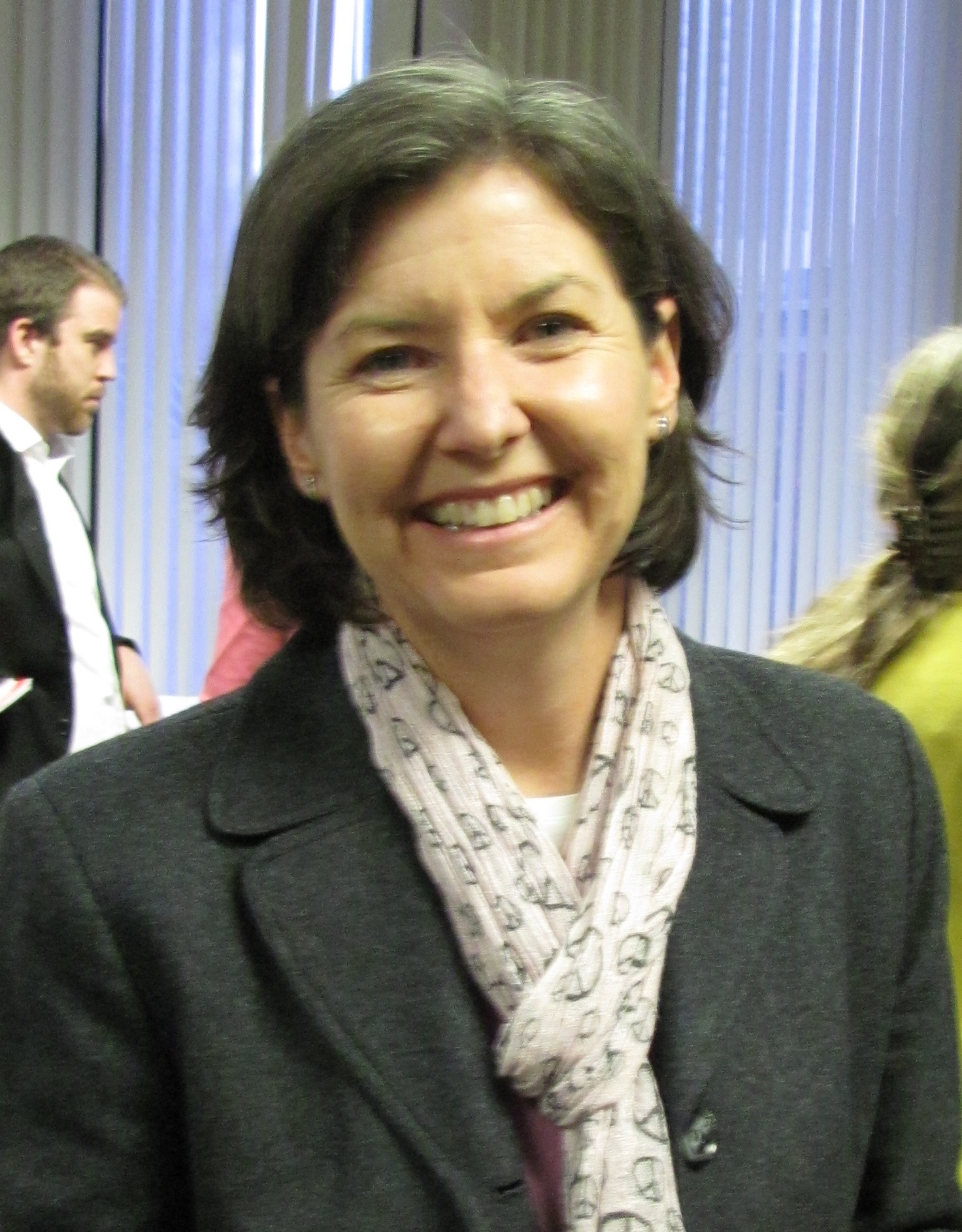
Carrie Sperling, at an Innocence Network meeting
“It was Carrie who opened my eyes to how much of this is going on,” Guthkelch sighs.
He says he never intended that the presence of subdural hematoma and retinal hemorrhages, with or without encephalopathy, should prove that a child had been shaken, only that shaking was one possible cause of the bleeding. “I am frankly quite disturbed that what I intended as a friendly suggestion for avoiding injury to children has become an excuse for imprisoning innocent parents.”
Sperling suggested he read law professor Deborah Tuerkheimer’s 2009 law-journal article on how shaken baby syndrome is handled in the courtroom. “She certainly nailed it,” he says of Tuerkheimer’s work. Some months later he saw some “harsh, unprofessionally harsh” criticism of that paper. When he tried to talk about it with people he knew from the child-protection community, he realized how wide the schism was. “There are cases where people on both sides, both of whom I admire equally, are barely able to speak to one another,” he told NPR.
He contacted Tuerkheimer, and the two of them hit it off. They speak regularly on the phone, he reports, and “we find we are of one mind on this subject.”
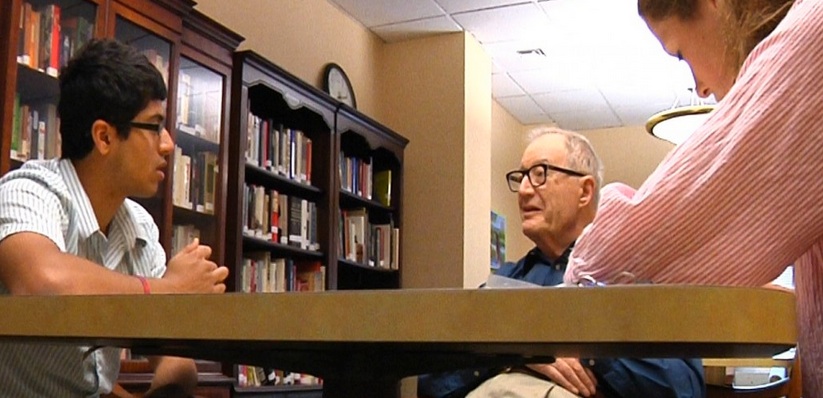
Meeting with students from the Medill School of Journalism
Photo by Alison Flowers, courtesy of the Medill Justice Project
After his wife’s death, Guthkelch moved to a suburb outside of Chicago, where he’s continued trying to be an ambassador between the two sides. When he learned that journalism students at the nearby Medill Justice Project had taken on a shaken baby case, he reached out to them. One result is a first-rate podcast that includes interviews with both him and Dr. Robert Block, president of the American Academy of Pediatrics. (2021 update: The Medill Justice Project has reorganized its web site; the shaken baby material is no longer available.)
When Dr. Sandeep Narang, pediatrician and attorney, published an argument that courtroom testimony about child abuse is best left to trained child-protection physicians, not paid experts, Guthkelch wrote the introduction to a rebuttal by a team of advocates for the innocent accused. (For a quick summary of Narang’s article and Guthkelch’s response, see this page.)

Dr. Ron Uscinski and Dr. Norman Guthkelch
October 2012
Guthkelch also spends what time he can reviewing cases. “Let me be quite frank,” he says, “For a 97-year-old I’m fairly well preserved, but my memory is not what it once was.” Producing a medical report takes careful concentration and more double-checking, as does following and responding to the literature.
But he perseveres. “I want to do what I can to straighten this out before I die,” he says, “even though I don’t suppose I’ll live to see the end of it.”
Which reminds me of something Carrie Sperling said about him when I spoke with her at the Twelfth International Conference on Shaken Baby Syndrome/Abusive Head Trauma in the fall of 2012. “I felt a little bit bad about getting Norman Guthkelch involved, because I knew he would become controversial” she said in a video dispatch posted on the Medill site. “I did warn him, but I don’t think there’s any way to warn people of how the wrath can come down on you when you get involved in this sort of thing… It’s amazing the effect he’s had on the experts I know, on the people I know. I’m hoping that he lives a long, long time so that he can meet with as many people as want to meet with him and talk to as many people as want to talk with him.”
copyright 2013, Sue Luttner
Dr. Guthkelch died quietly at home, surrounded by loved ones, in July 2016, weeks short of his 101st birthday. I posted this obituary.
For excerpts of my videotaped interviews with Dr. Guthkelch, conducted in October of 2012, please click on the image below:
If you are unfamiliar with the debate about shaken baby syndrome, please see the home page of this blog.
 On Shaken Baby
Pingback: The Law Must Respond When Science Changes - orrao.com
Pingback: Shaken Baby Syndrome Has Been Discredited. Why Is Robert Roberson Still on Death Row? - ReadFeed.in
Pingback: The Law Must Respond When Science Changes | Scientific American
Pingback: The Regulation Should Reply when Science Modifications - 9PT News
Pingback: La ley debe responder cuando la ciencia cambia – 7 minutos
Pingback: The Law Must Respond when Science Changes – BNS Global News
Pingback: The Law Must Respond when Science Changes - ReadFeed.in
Pingback: The Law Must Respond when Science Changes - ATS
Pingback: Texas Governor and AG Push Back Hard | On Shaken Baby
Pingback: The Law Must Respond When Science Changes - LocalTak
Pingback: Shaken Child Syndrome Has Been Discredited. Why Is Robert Roberson Nonetheless on Demise Row? - livenewsupdate.live
Pingback: Shaken Child Syndrome Has Been Discredited. Why Is Robert Roberson Nonetheless on Loss of life Row? – 24hournews
Pingback: Shaken Baby Syndrome Has Been Discredited. Why Is Robert Roberson Still on Death Row? | afeera.com
Pingback: Shaken Child Syndrome Has Been Discredited. Why Is Robert Roberson Nonetheless on Loss of life Row? - dailyupdatenews
Pingback: Shaken Baby Syndrome has been discredited. Why is Robert Robertson still on death row? - mediaonlinenews.com
Pingback: Shaken Child Syndrome Has Been Discredited. Why Is Robert Roberson Nonetheless on Demise Row? - CBN Live News
Pingback: Shaken Baby Syndrome Has Been Discredited. Why Is Robert Roberson Still on Death Row? – Jewish Digital Times
Pingback: Shaken Baby Syndrome Has Been Discredited. Why Is Robert Roberson Still on Death Row? - Vontanews
Pingback: Shaken baby syndrome is discredited. Why is Robert Roberson still on death row? - BLMS Media
Pingback: Shaken Baby Syndrome Has Been Discredited. Why Is Robert Roberson Still on Death Row? – Worldpostone
Pingback: Shaken Baby Syndrome Has Been Discredited. Why Is Robert Roberson Still on Death Row? – New York Examiner News
Pingback: Shaken Baby Syndrome Has Been Discredited. Why Is Robert Roberson Still on Death Row? – Monkey Viral
Pingback: Shaken Baby Syndrome Has Been Discredited. Why Is Robert Roberson Still on Death Row? - orrao.com
Pingback: Shaken Baby Syndrome Has Been Discredited. Why Is Robert Roberson Still on Death Row? – Beverly Hills Examiner
Pingback: Shaken Baby Syndrome has been discredited. Why is Robert Roberson still on death row? #technews - World Patriots
Pingback: Shaken Baby Syndrome Has Been Discredited. Why Is Robert Roberson Still on Death Row? - New Hampshire Digital News
Pingback: Shaken Baby Syndrome Has Been Discredited. Why Is Robert Roberson Still on Death Row? - suckleonthis.com
Pingback: Shaken Baby Syndrome Has Been Discredited. Why Is Robert Roberson Still on Death Row? – digixcity.com
Pingback: Shaken Child Syndrome Has Been Discredited. Why Is Robert Roberson Nonetheless on Loss of life Row? - 9PT News
Pingback: El síndrome del bebé sacudido ha sido desacreditado. ¿Por qué Robert Roberson sigue en el corredor de la muerte? – 7 minutos
Pingback: Shaken baby syndrome is discredited. Why is Robert Roberson still on death row? - vantagefeed.com
Pingback: Shaken Baby Syndrome Has Been Discredited. Why Is Robert Roberson Still on Death Row? – cokauniversity.online
Pingback: Shaken Baby Syndrome Has Been Discredited. Why Is Robert Roberson Still on Death Row? – Science News Hubb
Pingback: Shaken Baby Syndrome Has Been Discredited. Why Is Robert Roberson Still on Death Row? | Scientific American
Pingback: Shaken Baby Syndrome Has Been Discredited. Why Is Robert Roberson Still on Death Row? - ATS
Pingback: Shaken Baby Syndrome Has Been Discredited. Why Is Robert Roberson Still on Death Row? – ReadFeed.in
Pingback: Shaken Child Syndrome Has Been Discredited. Why Is Robert Roberson Nonetheless on Dying Row? - American News 24/7
Pingback: Good News, Bad News: the Tragedies Continue | On Shaken Baby
Pingback: The Forensic Unreliability of the Shaken Baby Syndrome: The Book | On Shaken Baby
Pingback: Dr. A. Norman Guthkelch Fought Injustice to the End | On Shaken Baby
after paying thousands and 3 yrs attorneys withdrew my grandson will now be defended by a public defender after reading your papers I am convinced that the baby died as a result medical issues / vaccines all symptoms present need your report if possible with diagnostic labs and images I and my daughter are LPN’s any material we can provide the public defender with will be greatly appreciated thank you
I’m so sorry to hear of another family drawn into this nightmare. The good news is that a public defender can be quite effective, and some of them are more open to accepting your help than private attortneys. I have sent you a private email with some white papers about the medical issues, written to orient attorneys new to the arena. Best wishes. Oh, have you found the Resources page on this blog site?
Pingback: The Word Is Out | On SBS
Pingback: Conversations With Dr. A. Norman Guthkelch | On SBS
Mr Norman Guthkelch operated on my self on july 18th 1960 at pendlebury childrens hospital at the age of 11years it was 2 abcess’s on the brain and one on the nerve of my eye my name was Elaine Tonge I will be 66 in August. I have never had problems with my memory i enjoy acting at my local amateur theatre.THANK YOU Mr Guthkelch for my life!!. God bless you to keep well.
Elaine Tyler
Pingback: Mississippi Death Row Inmate Jeffrey Havard is Innocent! - Occupy HLN
Dr Norman Guthkelch operated on my mothers brain in March 1960, when she was just 12years old, she is now 65 years a grandmother of 6 and has survived bowel cancer, she has never forgotton what he did for her, God bless you Doctor Guthkelch.
very nice article
What a great man! It is such a shame that not even with his words of caution do these “child abuse specialists” want to let go of their thrones in the reign of terror for innocent children and their parents. I still wonder how many children die because we’re not finding the root cause of this rather than blanket diagnose with abuse (it’s actually a rather easy diagnosis compared to all the testing and the time involved where the diagnosis is “I don’t know yet”).
I, also, have had the immense pleasure of meeting and conferring with Dr. Guthkelch on our baby case. He is a truly gracious, thoughtful and caring man. I consider him a friend, as I am also a birdwatcher, as is he.
He, even at 97, considered the medical facts of our case and referred me to colleagues in my state who are knowledgeable and active in speaking as expert witnesses for the defense against shaken baby allegations. I can’t say enough good about Dr. Guthkelch. He touched my heart and with fondness I will remember him always.
Wow. He is an impressive man! Thanks, Sue.
Important synthesis of the players and trends in this little understood issue, Ms. Luttner. Dr. Guthkelch seems like an extraordinary resource, pioneer and advocate. I understand that you will be producing a video. If it is non-commercial, we would love to run it on our channels. Let us know if you need support editing the piece.
Thank you so much, Ms. Sanders.
I am a novice in the video arena, and I would appreciate some support. I will be in touch when I’m more organized on that front. A thousand thanks for the offer.
When you are ready to work on the editing, tell us what format you shot the footage in and is on an SD card. And then do you have editing software or do you need a computer with editing software. We can can definitely help you get started to tell the story you want to tell.
Well done, Sue. A well-written piece about a fascinating man.
Write on Sue. I’m glad you’ve become so involved in this arena, and lend your formidable talent to enlightening so many.
I am so happy to read this post, thank you. It is wonderful that a seasoned medical professional has stepped into this overheated arena. The DOGMATISM and superheated “feelings” surrounding SBS prevent people – social workers, doctors and parents viciously eager to “convict” those accused- from actually thinking. It has long been required that someone just like Dr. Guthkelch bring some slow, reasoned, weight to this subject.
Thank you for posting. I agree: The dogmatism, combined with a misguided assumption that pressing these cases is somehow helping children, interferes with logical, reasoned thinking.
What a great story on a great medical professional ! Good to have the background for his involvement in this arena.
Thanks
Nice work!