Category Archives: shaken baby syndrome

Father Not Guilty in Minnesota

A Minnesota jury found a father not guilty this week on all three counts against him stemming from the 2009 death of his 4-month-old son.

Piecing together the available press reports, the trial seems to have taken two weeks, with the prosecution resting on Monday, April 23.  The defense started its case on Tuesday morning, followed by closing arguments and a jury decision on Wednesday, April 25.

The background:  Defendant Damien L. Marsden was at home with his 4-month-old son Rylin for approximately half an hour on August 2, 2009, while the boy’s mother was out shopping. Marsden was reportedly grilling hamburgers outside. When the boy’s mother arrived home, the two of them went inside together, found the boy “pale and lifeless,” and called 911.

During defense testimony the child’s grandmother, Tammy Klein, told the court that the infant had been dropped at her day care facility just a week before the incident, on July 23, which left him crying and with a red mark on his head. The elder Marsden reported that his son had fallen from a bed on August 1, the day before he was rushed to the hospital.

Prosecution witness Dr. Arne Graff, however, testified that the boy died from “non-accidental head trauma” that could not have been caused by a short fall.

After Graff’s testimony, reporter Chris Bieri of the Grand Forks Herald wrote

Graff, a child abuse pediatrics specialist from Sanford Health in Fargo, maintained that the condition responders found Rylin Marsden in was an immediate response to trauma, not a reaction to an earlier fall or accident.

He said the spreading of blood in Rylin Marsden’s head was consistent with a rotational injury or shaking, not just an impact injury.

Graff said during an examination of the child, he noticed retinal hemorrhage and said the results of a CT scan showed brain bleeding, both consistent with having his head shaken.

Graff said there was nothing in Marsden’s medical or family history that would have complicated a different type of injury, causing it to become deadly.

Forensic pathologist Jonathan Arden testified for the defense, as described in a later article:

Arden, an expert anatomic and forensic pathologist based out of northern Virginia, provided testimony supporting a theory that Rylin Marsden’s hospitalization and eventual death were the result of a pair of falls, the first coming at Klein’s daycare.

Arden’s theory was initially based on his finding that there were signs of two different injuries, and that re-bleeding of the initial injury in the boy’s head caused him to be hospitalized on Aug 2.

The second injury was purported to be a barely more than 2-foot fall from a bed onto a carpet on Aug. 1. Arden said the timeline of injuries on July 23 and Aug. 1 were consistent with what he saw in the healing of initial injury and re-bleeding.

Arden went over a number of CT scans with the jury and testified that his reading of initial CT scans having both fresh and healing hemorrhages were in agreement with a case radiologist’s findings.

Prosecutors inferred Arden was a witness for hire — he runs a consulting firm and testified to charging $400 an hour for consulting and $4,000 per day for court appearances.

The trial also featured the new trend toward avoiding the phrase “shaken baby syndrome” in favor of “abusive head trauma” or “non-accidental head trauma.” The coverage of the defense testimony included this report:

Klein testified Graff continually told the extended family he knew it was a shaken baby, a term Graff said under oath on Monday he didn’t use.

Another day’s coverage read:

There also was testimony on the term “shaken baby syndrome,” which Graff said he only uses to describe what is now referred to as “non-accidental head trauma.”

In summary, this case sounds like a classic of the genre. The earlier articles seem no longer to be on line, but the final Grand Forks Herald article is at:    Marsden Found Not Guilty on All Three Murder Counts

Leave a comment

Filed under abusive head trauma, AHT, SBS, shaken baby syndrome

Surfing the Web With Shirley Smith

Governor Jerry Brown’s decision earlier this month to commute the sentence of Shirley Ree Smith has given shaken baby syndrome another run in the news, where the coverage shows a new awareness of the changing landscape.

The day after the announcement, for example, NPR reporter  Joe Shapiro said on a segment of All Things Considered,  “now doctors and scientists  have a better understanding of other causes . . . that can mimic the signs of child abuse.”

In an excellent piece on ProPublica, reporter A.C. Thompson found room in the second paragraph to mention the new, conflicting analyses of the medical evidence released a few days before the clemency announcement.  Los Angeles District Attorney Steve Cooley had asked for expert reviews of the evidence in Smith’s case, and he received three quite different reports, two of them raising questions about the conviction.

From the District Attorney's letter to Governor Brown

The ProPublica web site has also posted a fascinating document, the letter from District Attorney Steve Cooley to Governor Jerry Brown, sent in January while Brown was considering the request to commute Smith’s sentence. The main point of the letter is not Smith’s guilt or innocence, but, as the letter puts it, “the current state of the science that forms the foundation for Abusive Head Trauma (AHT, which was formerly, colloquially referred to as Shaken Baby Syndrome (SBS)).” Cooley cites informational materials from the U.S. Department of Health and Human Services, a journal article, and a legal decision to support his point that “AHT is widely accepted by both the medical and legal communities as a diagnosis and cause of death.”

Which strikes me as irrelevant to both Shirley Smith’s case and the debate surrounding shaken baby syndrome. The question at hand is is:  Does the evidence prove that Etzel Glass died from a shaking assault? The larger question is:  Does intracranial injury prove abuse without other signs of violence?

Presumably the letter to Governor Brown was drafted in response to the statement in support of clemency  submitted by Ms. Smith’s attorneys in December. Although that document does quote from Supreme Court Justice Ruth Bader Ginsburg’s minority opinion in the Supreme Court decision, the bulk of the document addresses the evidence in Smith’s case. I have to conclude that the main goal of Mr. Cooley’s letter was to head off any reference by Governor Brown to the debate surrounding a diagnosis of shaking.

Brown’s commutation order did not in fact reference the wider debate, although it did quote Justice Bader’s minority opinion in the Supreme Court decision that “there has very likely been a miscarriage of justice in this case.”

Los Angeles Times reporter Carol J. Williams quoted from both Cooley’s letter and the new, conflicting reviews of the evidence in her follow-up story that ran the day after the governor’s announcement. That treatment also reveals a little bit more about Smith, who found herself homeless in Los Angeles for a time after her release from prison, because she was not allowed to leave the state and therefore could not rejoin her daughter and grandchildren in Illinois.

The day of the announcement, Emily Bazelon at Slate wrote a quick but thorough piece concluding that  Smith’s case could give other innocent people in prison “a shot at getting their lives back.” Bazelon reiterated her position from the  winter 2011 article  in The New York Times Magazine, that “the science underlying shaken-baby prosecutions is shifting, with critics arguing that alternative explanations are not adequately explored. But a new concensus—legal or scientific—hasn’t yet emerged from the bitter fight, in some cases, over the diagnosis.”

In the on-line ABA Journal coverage, reporter Martha Neil wrote, “Smith’s case is one of a number of convictions in which evidence once thought to be determinative concerning shaken-baby deaths is now being questioned.” The two reader comments that made it past the moderator have both been in support of the commutation.

Shirley Smith is now living with her daughter in Minnesota, where CBS News in Minneapolis ran a touching interview that did not address the medical issues, and a CBS/Fox station prepared a feature segment that was even briefer. Neither posting on the internet seems to have received reader comments.

The Associated Press syndicated a story, picked up at least by USA Today, that did not refer to the larger debate but did cite a number of statements in Smith’s favor.

SFGate in San Francisco posted the Chronicle’s coverage, which evoked both positive and negative reactions from readers. The piece was short, but reporter Bob Egelko summarized the situation surrounding both Smith’s case and the larger question in one accurate paragraph:

Recently, however, a pathologist in the coroner’s office reviewed the case and found little evidence of traumatic injury. Some researchers have also questioned the validity of shaken-baby syndrome, a term doctors have used for 40 years to describe often-fatal head injuries suffered by small children with no outward signs of abuse.

A site called The Inquisitr pulled together an article of its own from a number of sources. For whatever reason, maybe the unfortunate headline, reader comments on that site have been 100 percent negative.

Blogger Kate Jane posted a short piece asking for reader comments, which hasn’t received much response.

I doubt I’ve found them all.  Please let us know if you come across something interesting I’ve missed.  Thanks.

-Sue Luttner

2 Comments

Filed under abusive head trauma, AHT, SBS, shaken baby syndrome

Clemency Granted for Shirley Smith

Governor Jerry Brown commuted the sentence this morning of Shirley Ree Smith, whose case will remain a landmark in the arena. Shirley and her family are jubilant, of course, even though her conviction stands.

“I’ve been waiting so long for this day,” she said on the telephone this afternoon, “I can’t believe it’s finally here.”

Shirley said she was especially grateful to the people who helped her, directly and indirectly. “I would like to thank everyone who stood in my corner and fought for justice with me all these years,” she said, “I did not have to stand alone.”

Justice is not complete, Smith conceded, as she still has a criminal record, “but I can get on with my life now, and the story will help people find out what’s going on with shaken baby syndrome.”

In an interview in January, while waiting for the results of the clemency petition, Shirley’s daughter Tomeka Smith reflected, “In a way we don’t want the clemency, because that means she’s done something wrong and she needs to be pardoned. That’s sad. That’s not what she wants.”

This morning, though, when the phone call came from the attorney, “We were all clapping and jumping and shouting and hugging, the whole family,” Tomeka said, adding, “Still, we’d like to see something official, a piece of paper, to let us know it’s really over.”

As followers of this blog know, Shirley Smith was convicted in 1997 for assault on a child resulting in death. The child was Etzel Glass, Tomeka’s youngest, 7 weeks old at the time. The family was staying with relatives and Shirley was sleeping in the living room with her grandchildren, while Tomeka slept in the bedroom a few feet away. Shirley says she found Etzel unresponsive at about 3 am and brought him in to Tomeka, who called 911.

At the hospital, doctors found only one of the three signs usually used to diagnose infant shaking:  subdural hematoma. At Smith’s trial, Dr. Eugene Carpenter and Dr. Stephanie Ehrlich from the Los Angeles County coroner’s office testified that Etzel had died instantly when his brainstem was torn during a shaking assault, leaving no time for the other symptoms to develop.

Smith has had the full support of her family, from the moment a social worker first raised the question of abuse. “Of course my mom is innocent,” Tomeka said in January. “She would never hurt one of her grandkids.”

Smith served a decade in prison before the Ninth Circuit Court vacated her conviction on appeal in 2006, declaring the evidence against her constitutionally inadequate. Since then she has been out of prison but constrained in her movements while the state appealed the circuit court’s decision.

That appeal reached the Supreme Court this past fall. The high court reinstated her conviction, but in a ruling that didn’t address her guilt or innocence: their argument was that the appeals court should not override a jury’s decision. The written opinion even recognized that doubts about her guilt are “understandable,” and it contained a potent dissenting opinion from Justice Ruth Bader Ginsburg that outlined the substantial medical evidence against the traditional model of shaken baby syndrome. (The full opinion is available at this link.)

Through it all, Shirley Smith has kept her faith and her spirit, proving the value of a supportive family. DePaul University law professor Deborah Tuerkheimer, a critic of convictions based solely on the triad (see her op ed from fall 2010), recently called Shirley one of the “incredible figures in this saga.”

The LA Times report about today’s clemency announcement contains only the bare facts, but the news is good.

Shirley says she’s already been called by both national and local news teams, so look for more news stories on her case. Her first television interview is this evening.

If you’re not familiar with shaken baby syndrome and the arguments surrounding it, please see the home page of this blog.

14 Comments

Filed under abusive head trauma, AHT, SBS, shaken baby syndrome, Uncategorized

Shirley Ree Smith Update and More

While Governor Jerry Brown considers the clemency request for Shirley Smith, two new physicians have registered conflicting opinions about the cause of her grandson’s death, after Los Angeles District Attorney Steve Cooley requested  a review of the evidence.

The article in the Los Angeles Times about the new developments, by reporter Carol J. Williams,  includes this fascinating paragraph:

In a letter to the governor that Cooley’s office made available, the district attorney said he was mindful of Smith’s lack of criminal history, age and good behavior in prison, indicating that he wasn’t opposed to clemency on “equitable grounds.” But he cautioned Brown against rejecting “the well-documented and widely accepted medical diagnosis, AHT,” saying that would undermine public confidence in diagnoses of child abuse.

I might be starting to understand why the district attorney won’t just admit that the medical facts don’t support a diagnosis of shaking in Smith’s case:  If he concedes that she might be innocent, her trial demonstrates how easy it is for a jury to convict on the basis of sincere but unproven medical opinion.

Williams also posted a blog on the subject at  http://www.latimes.com/news/local/la-me-shaken-baby-evidence-20120330,0,6785859.story

Meanwhile, the Huffington Post has published a poignant update on a tragic case of mistaken child-abuse diagnosis:  Much too late for the parents, victims of an apparent murder-suicide, doctors now acknowledge that the couple’s 3-month-old daughter was suffering from a debilitating genetic disorder.

Leave a comment

Filed under abusive head trauma, SBS, shaken baby syndrome, Uncategorized

Shirley Smith’s Case: NPR, ProPublica, and FrontLine Still Covering SBS

Morning Edition aired a story about Shirley Smith this morning, at http://www.npr.org/2012/03/29/149576627/new-evidence-in-high-profile-shaken-baby-case

ProPublica also has a story posted, with excerpts from the FrontLine interviews:  http://www.propublica.org/article/video-shirley-ree-smith-in-her-own-words

Leave a comment

Filed under abusive head trauma, AHT, SBS, shaken baby syndrome

Ernie Lopez Case Keeps Issues in the News

NPR, FrontLine, and ProPublica are staying with the story of Ernie Lopez, keeping one tale of an outrageous conviction in the news.

In January, a Texas Court of Appeals vacated Lopez’s conviction for the presumed assault on a 6-month-old girl. Last week he was released from prison, to an exuberant welcome by family and friends, who promptly held a concert to raise money for his upcoming legal fees.

Amarillo County District Attorney Randall Simms has said he plans to retry the case, possibly as early as this fall.

The NPR segment about Lopez’s release is posted on line, with a succinct text summary of the medical issues, and links to previous NPR coverage of the case.

The ProPublica text story, which also addresses the medical issues, has embedded links to segments of the FrontLine video treatment, for a satisfying multi-media experience.

The audio and video treatments present more of the human side to the story, which is incredible in itself: Ernie Lopez seems to be a man of tremendous resilience, faith, and grace, treasured by his family and community.

2013 update: Ernie Lopez accepted a plea bargain, admitting to a felony but facing no more prison time.

Leave a comment

Filed under abusive head trauma, AHT, Ernie Lopez conviction, SBS, shaken baby syndrome

New Research Questions Classic Model of Shaken Baby Syndrome

Kieran wired up and ready to jump

When Kieran Lloyd was seven months old, his favorite way to pass the time, right after eating and sleeping, was bouncing in his Fisher-Price Jumparoo.

He would bounce eagerly, smiling and laughing, several times a day if he was given the chance, apparently delighted with the upright posture and the kinetic results of his own kicks.

Then his father, head-injury researcher John Lloyd, PhD, realized that before him danced a chance to measure and record an important new data point in the accumulated knowledge about infant head-injury: A magnitude of repetitive angular acceleration that’s known to be safe.

He fitted his son with an accelerometer, like those used on crash-test dummies in the lab, and collected data while the boy played. By the time Lloyd was done, he had not only replicated the original 1987 research that first cast scientific doubt on infant shaking as a source of subdural hematoma but also refuted the hypothesis that repetition can make a benign acceleration injurious.

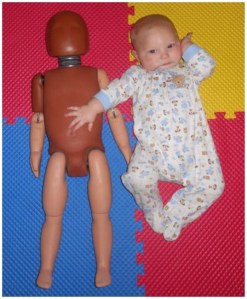
Kieran with the CRABI-12 biofidelic mannequin

In a paper published this winter in the Journal of Forensic Biomechanics, Lloyd and his colleagues reported that “angular acceleration of the head during aggressive shaking of the CRABI biofidelic mannequin is statistically indistinguishable from angular head kinematics experienced by a 7-month-old fervently playing in his Jumparoo.”

Lloyd’s paper joins a series of biomechanical studies that have all reached the same conclusion:  Shaking is unlikely to be the source of subdural hematoma in children with no signs of impact or neck injury, despite decades of courtroom testimony to the contrary.

Although the theory of shaken baby syndrome has enjoyed thirty years of general acceptance within the community of child-abuse experts, the diagnosis has been controversial from the beginning. Testing it of course was impossible.

In the mid-1980s, Dr. Ann-Christine Duhaime and her colleagues set out to investigate whether shaking without impact could cause the intracranial bleeding and swelling that defines the syndrome. They examined medical records and revisited autopsy slides, and they conducted laboratory experiments in which adult volunteers shook infant models wired with accelerometers.  They found that shaking without impact did not reach the presumed thresholds for the intracranial bleeding or neuronal damage that’s presumed to result from shaking.

Then the researchers asked their volunteers to throw the dummy down after shaking it, and learned that accelerations upon impact reached injury levels, as illustrated in Figure 2 from their paper (“The Shaken Baby Syndrome:  A clinical, pathological, and biomechanical study,” Journal of Neurosurgery 66:409-415, 1987). The shaking data are the cluster of points at the lower-left corner; the triangles are impact trials. DAI stands for diffuse axonal injury; SDH stands for subdural hematoma.

Duhaime and her team concluded, “Although shaking may, in fact, be part of the process, it is more likely that such infants suffer blunt impact. The most common scenario may be a child who is shaken, then thrown into or against a crib or other surface.”

Lloyd did not conduct impact trials, but his shaking data were in the same range as not only Duhaime’s data but also those of Prange et al., who replicated the original work in 2003  (“Anthromomorphic simulations of falls, shakes, and inflicted impacts in infants,” J Neurosurgery 99:143–150, 2003).

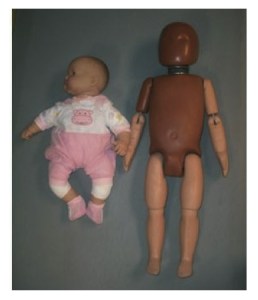
The NCSB demonstration doll and the CRABI-12 biofidelic mannequin

To help establish a base line for the forces commonly experienced by an infant, Lloyd also recorded acceleration data during what are called “activities of everyday living,” or ADLs. Adult volunteers rocked and burped the wired crash-test dummy, walked and ran on a treadmill with it, and took it for stroller rides over various surfaces.

Lloyd also had volunteers shake the demonstration doll sold by the National Center on Shaken Baby Syndrome. The doll is commonly used in trainings, and occasionally it’s allowed in court. The doll weighs only two pounds and volunteers were able to shake it longer and harder than the CRABI-12, producing higher angular accelerations—but still not high enough to reach projected injury thresholds.

Figure 7, below, from Lloyd’s paper summarizes the accelerations recorded during various scenarios. The entire article is available on line at this address.

8 Comments

Filed under abusive head trauma, AHT, SBS, shaken baby syndrome

What to Make of the “Baby Yoga” Phenomenon

from the Mirror web teaser

Even I am uneasy with the subject, but I don’t see how an SBS blog can ignore this week’s tabloid news reports of “baby yoga” exercises, in which infants are flipped and swung and tossed by therapists.

The most startling videos are on the Mirror News web site out of the United Kingdom, where they have posted the entire televised segment on the subject. The  Daily Mail Online text treatment offers a video near the end showing several minutes of one routine by therapist Lena Fokina.

The web site GrowingYourBaby.com has a cautionary treatment featuring video sequences of parents performing the gymnastics on their own babies at a class in Egypt. The possibility remains that these videos are doctored, but if so, there’s been a lot of editing going on.

Myself, I find these exercises terrifying:  I’m at least relieved that most of the baby-juggling seems to be done over sand. I sent the urls to a few experts, none of whom had heard of this phenomenon before.

Biomechanic John Lloyd, PhD, noted:

I see that the baby-yoga instructor, Lena Fokina, moves very carefully in tune with and in time to the baby’s motion. Her skill must take great practice and it worries me that anyone not possessiong such skill might attempt these exercises.

I have little doubt that the rotational head kinematics would be akin to those during aggressive shaking and enthusiastic playful activities, all of which, in the absence of impact, would be well below any threshold for brain injury.

My greater concern is the potential for spiral fracture of the long bones and/or adverse events such as falls.

Pediatric surgeon Anthony Shaw, MD, independently recalled an anecdote that validated Lloyd’s long-bone concerns:

Some years ago I was consulted on the case of a weeks-old infant who was discovered to have metaphyseal fractures of both ends of all his long bones. His father, a body builder, had been told that exercise was good for his baby’s bones and muscles. He made a video that he brought to court, in which he substituted a doll for the baby, to show the court what he had been doing with his infant son. It looked exactly like the maneuvers that this Lena Fokina displays on her video.

Does anyone else know anything about these “baby dynamics” techniques?

1 Comment

Filed under abusive head trauma, AHT, SBS, shaken baby syndrome

Cases, Cases, and More Cases

More bad news than good lately from the front lines in the SBS struggle. Fathers and men watching other people’s children have been especially in the headlines this month.

In the one positive development, a Michigan jury has acquitted a man who was watching his employee’s 3-month-old son so the boy’s father could work. The prosecution had applied the theory of immediate but subtle symptoms to target the babysitter, although the serious problems emerged later, while the child was with relatives. The defendant’s damning act was apparently asking his mother-in-law to check on the baby, as he thought the child was having trouble breathing. See the coverage in the Pestosky News.

A 42-year-old  man in Oklahoma has entered an Alford plea, which is not strictly a confession of guilt but an acknowledgment that the prosecution would probably win at trial. The original charge was first-degree murder, reduced to manslaughter with the plea. According to the story in the Enid News, the defendant  called 911 when a 7-month-old boy in his care seemed to choke on a bottle and quite breathing, in September of 2009.

A terrifying case is heading toward the death penalty in Mississippi, where a man claims to have dropped his girlfriend’s daughter after giving her a bath. He was convicted of capital murder after prosecutors argued he had both battered and raped the girl.  A rape kit administered at the time showed no signs of semen, but the child’s dilated anus—a normal finding near or after death—convinced the doctors that she’d been sexually abused. You can read about this case in the Clarion Ledger coverage. In light of the prosecution of Ernie Lopez, one has to wonder if misdiagnoses of sexual abuse will now start showing up routinely in child-death cases.

In New Hampshire, meanwhile, on-line comments have been especially venomous against a young father accused of shaking his son while the child’s mother was in another room drawing a bath. I admit the young man looks like trouble in the published photographs, but the facts as reported in the Eagle Tribune coverage sound like the same old story to me.

A judge in Colorado has sentenced a father to 20 years in prison after he confessed to shaking his 2-month-old, as reported by their local channel 9 news, and a father in New Jersey has been charged in the death of his 11-week-old daughter, as reported by abc news.

A day care provider in Missouri is scheduled for trial this fall, accused of hitting and shaking a girl in her care. According to an article on Connect MidMissouri, the babysitter says she tripped over another child and dropped the baby.

And finally, an appeal in Britain has hit the usual wall, as reported in Family Law.

3 Comments

Filed under abusive head trauma, AHT, SBS, shaken baby syndrome

Florida Care Provider Convicted

August 2012 update:

Stephanie Spurgeon has been sentenced to 15 years in prison. If there is information about an appeal, I will try to post it.

A Florida jury has convicted child-care provider Stephanie Spurgeon of manslaughter, despite testimony from neuropathologist Dr. Jan Leestma that the infant’s death could have resulted from non-violent causes. Spurgeon was facing first-degree murder charges, so the manslaughter conviction is a better outcome than she might have had.

The news report of the conviction seems to have been taken off the web.

For the news stories I noticed during the trial, you can check out

February 10 coverage

February 8 coverage

Her suporters maintain a facebook page for her at http://www.facebook.com/pages/The-Stephanie-Foundation/231645840262829

5 Comments

Filed under abusive head trauma, AHT, SBS, shaken baby syndrome