Tag Archives: abuse misdiagnosis

A County Faces the True Cost of Misdiagnosis

A ground-breaking report from a county controller in Pennsylvania last month articulated the fiscal costs of child abuse misdiagnosis, while a collection of local families propelled the financial story into the news by sharing their own heart-breaking experiences with local governing boards.

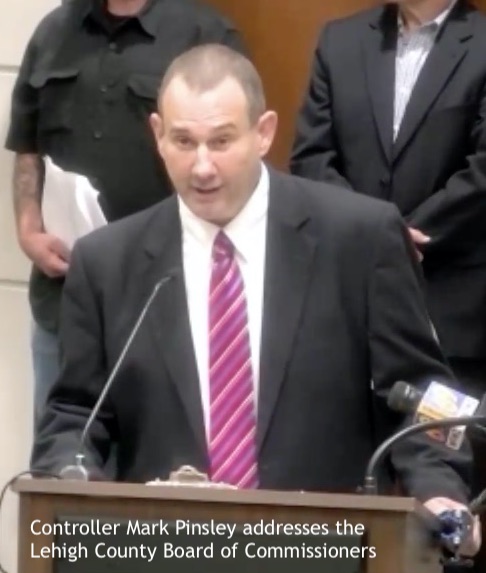
“My duty is to be a watchdog of public funds,” explains Lehigh County Controller Mark Pinsley, whose investigation, “The Cost of Misdiagnosis,” concluded that the county wastes money on unnecessary foster care, social and police services, litigation expenses, and more due to the over diagnosis of child abuse.
The report reveals that, in the long run, after families have been torn apart and resources have been expended, when cases reach independent appeals boards, judges have been overturning 90% of the county’s findings of “indicated” abuse.
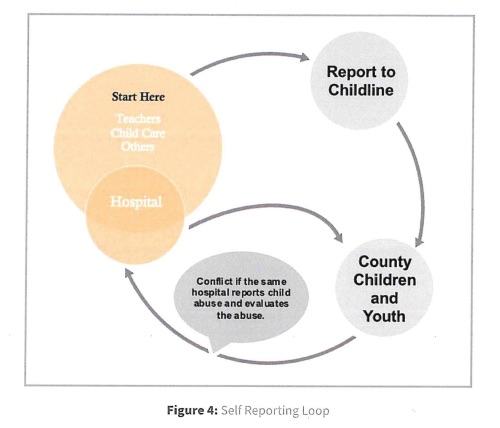
The report also noted the self-reinforcing nature of the process when doctors at local hospitals report potential abuse to the county, which then asks for an investigation by the Child Advocacy Center (CAC) at Lehigh Valley Hospital, run by the same hospital system. The illustration here is from Pinsley’s report.

The families who followed Pinsley at the podium the evening he addressed the Lehigh County Board of Commissioners spoke of their own pain and the damage to their children—even parents who eventually saw the charges dropped and their children returned said they were left emotionally and financially drained. One mother said she divorced her husband to comply with the demands of social services. The official report does not name names, but the parents, one after another, asked that Dr. Debra Esernio-Jenssen, then the director of the CAC, be fired.

So far, the Lehigh County commissioners have only passed the official report on to the state and county Departments of Human Services, but the Lehigh Valley Health Network (LVHN) apparently heard the message: Last week the network announced the appointment of a new director of the CAC and the reassignment of Dr. Esernio-Jenssen to “other” locations.

Pinsley started his investigation earlier this year, when a TikTok video by defense attorney Beth Alison Maloney alerted him to a local cluster of Medical Child Abuse (MCA) diagnoses.
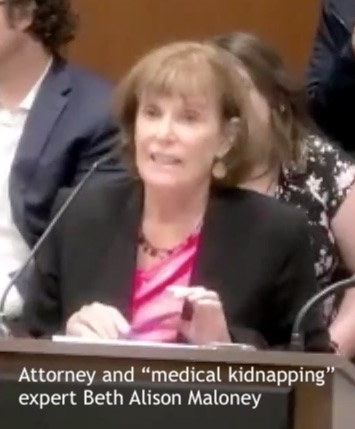
Also known as Munchausen Syndrome by Proxy (MSBP), MCA is a diagnosis directed at a parent who seeks unnecessary medical care for a child, fabricating or even causing mysterious symptoms. With 11% of Pennsylvania’s children, Pinsley’s report notes, Lehigh County and its neighbors Northampton and Carbon Counties account for 40% of the state’s MCA cases, a statistic that points to “potential systemic overdiagnosis of this rare disorder.”

The report cites a number of individual cases in which the child-abuse pediatricians ignored previous diagnoses of rare but legitimate medical conditions by other doctors in favor of MCA, only to backtrack later. The report recommends a number of changes in how the county handles abuse diagnoses, including independent investigation of each case by police and social services, which historically have deferred to the opinions of the local abuse specialists.

After he started his research, Pensley wrote, it became clear that he needed to look beyond MCA, “that the inquiry needed to include other areas, such as shaken baby syndrome, various forms of head trauma, and other rare diseases typically classified as child abuse.” Some of those cases also appear in the report.

Pinsley says he was “not the hero” in this effort; he was merely responding to a call for help from a group of local parents who had organized themselves as the Parents Medical Rights Group (PMRG).

“They didn’t need me,” he insists, “I was like the feather in the Dumbo movie. They could fly; they just needed the confidence to try.”

2024 Update: The parents filed a lawsuit against Dr. Ersonio-Jenssen in February of 2024, and she retired in March.

You can read some of the coverage in the regional paper The Morning Call before the pay wall kicks in:

  • In August, it covered the controller’s report and the first parent presentations to the Lehigh Valley commissioners
  • Last week, it reported the change in leadership at the CAC and a repeat presentation by the parents to the commissioners of neighboring Northampton County.
  • On Sunday it ran an op ed by Pinsley about his report

November 2025 update: A father convicted of murder based on a diagnosis by Dr. Esernio-Jenssen has been released from prison, in a bittersweet development, ‘It’s surreal’: Lehigh Co. man freed after 9 years in prison over flawed testimony on infant death

copyright 2023, Sue Luttner

A few source references, for more information.

If you are not familiar with the debate surrounding Shaken Baby Syndrome, please see the home page of this site.

4 Comments

Filed under Child abuse misdiagnosis

Affected Families Spark Change

Wrongly accused parents in Texas are on a roll. They’ve pushed through a state bill giving accused families the right to a second opinion on a child abuse diagnosis, and now a tweak that requires that opinion to come from a treating physician, not just another child abuse pediatrician. Another recent Texas law requires CPS to inform parents of their right to record interviews. How are they doing it?

Rana Tyson, a parent who pushed the second-opinion legislation, ascribes their success to a large and active community of accused families, plus whatever force—Rana says she credits God—provided them an audience at the statehouse.

“It started with this opportunity to tell our personal stories to legislators,” Rana explains, “To show them what this does to a family—not just our family, lots of families… It’s been a collective effort.”

Rana and her husband Chad lost custody of their three daughters in 2010, after child abuse pediatricians diagnosed their month-old twins as victims of abuse. Their own family doctor rejected that conclusion and helped the Tysons find the specialists who eventually diagnosed the girls with Ehlers-Danlos Syndrome (EDS), a connective-tissue disorder that can predispose to broken bones and bleeding. Their children came home, although it took additional hearings and another 18 months to have the “reason to believe” finding removed from the CPS records.

Through friends of friends and then media exposure, Rana started meeting other parents with similar stories. In 2013, Dallas news reporter Janet St. James broadcast a segment named Fractured Families featuring Bria and Andrew Huber, also exonerated by an EDS diagnosis. Soon after, both the Tysons and the Hubers told their story on Katie, a national talk show hosted by news veteran Katie Couric. Both reporters were deluged with messages from parents who said they were in the same position.

Then in 2016, Rana answered an unexpected knock on the door to meet Cindy Burkett, her state representative, who was out campaigning for re-election. Rep. Burkett said she wanted to know what was on her constituents’ minds, and so Rana told her.

Since then, Burkett and now other state legislators have held hearings and sponsored legislation, trying to stem the swell of child abuse overdiagnoses.

SB1578, passed last year and written by Sen. Lois Kelkhorst (R), filled a gap in a first piece of second-opinion legislation pushed by the same families, explains Andrew Brown, J.D., vice president of policy at the Texas Public Policy Foundation, who lobbied for both the second-opinion bill and the CPS-interview bill. Since the passage of SB1578, the second opinion now has to come from “a doctor who specializes in diagnosing and treating an underlying health condition,” Brown emphasizes, which prevents a second child abuse pediatrician from applying the same flawed guidelines and reaching the same flawed conclusion as the first. Most child abuse pediatricians diagnose but do not treat patients.

SB1578 includes the same list as the original bill of conditions commonly mistaken for abuse—rickets, EDS, osteogenesis imperfecta, and Vitamin D deficiency—but expands the scope to not only “similar” diseases but also “other medical conditions that mimic child maltreatment or increase the risk of misdiagnosis of child maltreatment.”

Other new provisions specify that

  • state actors cannot remove a child from the family based on the opinion of a physician who has not examined the child in person and
  • the Department of State Health Services must take into account the opinions of specialists consulted by the families at their own expense

While considering SB1578, lawmakers heard from the Hubers and the Tysons as well as a series of other parents, including:

  • Ann-Marie Timmerman, whose son’s findings stemmed from a combination of factors, including a brain bleed from birth trauma
  • Lorina and Jason Troy, whose son had benign external hydrocephalus (BEH), an especially large space between the brain and the inside of the skull that can predispose to bleeding
  • Holly Simonton, whose son had only an accidental bruise considered suspicious by the child abuse pediatricians

Aside from their legislative work, Bria Huber, Rana Tyson, and Rebecca Wanosik in Missouri run a non-profit parent-support organization, Fractured Families, that offers community and advice to newly accused families.

In the spring of 2022, the Family Justice Resource Center (FJRC), an Illinois nonprofit committed to evidence-based medicine in the courtroom, awarded Lorina Troy its annual Child Advocacy Award for her work publicizing the problem of abuse overdiagnosis, pushing legislators, and helping accused families.

Statistics are not available on how effective SB1578 in Texas will be, but a segment of the Canadian news program W5 featured a promising anecdote in February 2022. The segment featured the Timmermans’ story and included an interview with their attorney, Dennis Slate, who said he’d fielded 4-5 calls a month from parents saying were wrongly accused of abuse based on a medical opinion. Since the new law took effect in the fall, he said, “I have not had a new client come in and hire me on a broken bone or a fractured skull or a medical abuse or any of those other claims.”

A similar bill passed last year in Arkansas, “Quincy’s Law,” based on the Texas law. Activist father Zachary Culp, who proposed and championed Quincy’s Law, offers his template to families in other states interested in pushing for the right to a second opinion. Watch this space for the story of how Zachary built support for his bill in the state capitol one elected official at a time.

Press coverage of SB1578:

Text of the two bills:

-Sue Luttner

If you are not familiar with how often and how easily children are misdiagnosed as the victims of abuse, please see the page on this site addressing the larger medical issues.

If you are not familiar with the debate over Shaken Baby Syndrome (SBS), please see the home page of this blog.

1 Comment

Filed under Uncategorized