
In Texas, where the House Criminal Jurisprudence Committee thwarted the Justice Department’s execution last month of convicted father Robert Roberson, the struggle between the governor’s office and the legislature is now playing out both in the courts and in the headlines.
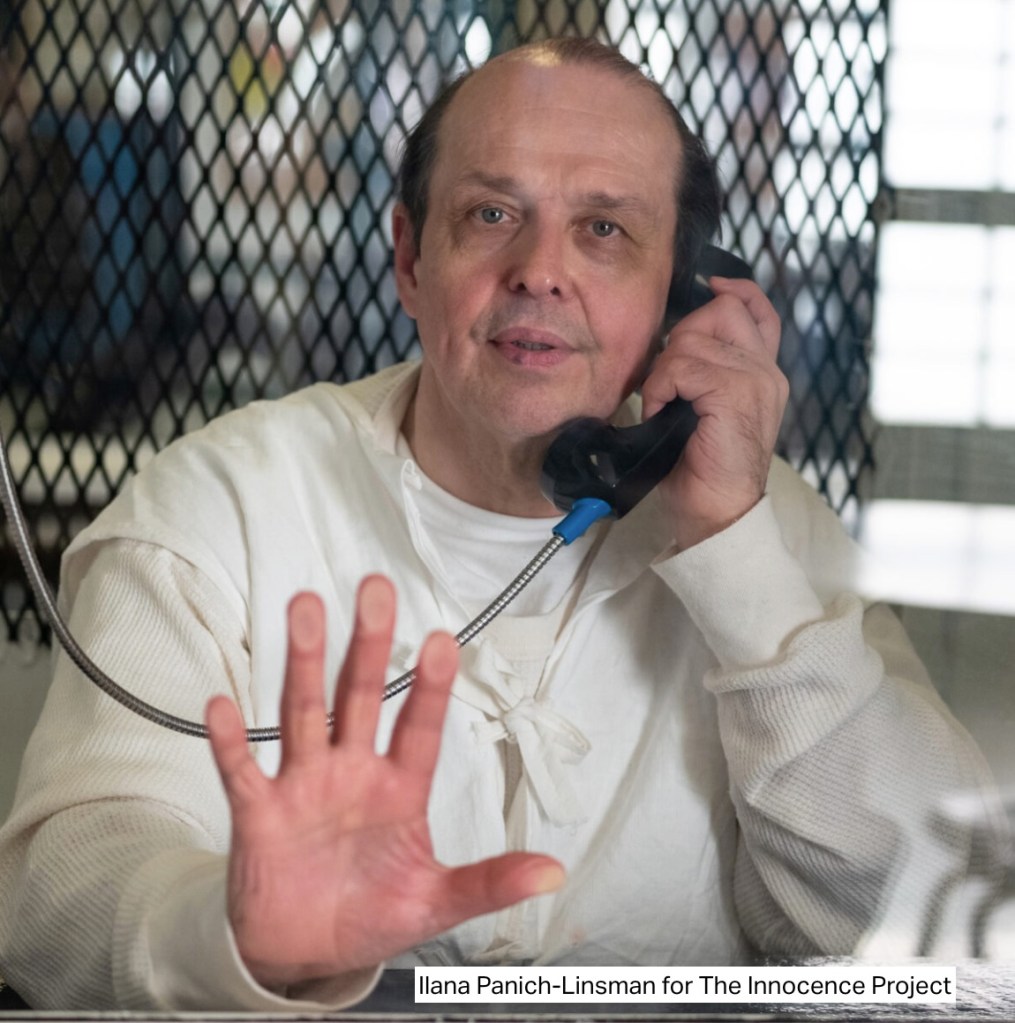
Roberson was convicted in 2003 of murdering his 2-year-old daughter Nikki by shaking, a diagnosis accepted at the time even by his own defense attorney but now in question, both generally and in this case.
Days after the Texas Supreme Court stayed the execution in October, Governor Greg Abbott’s office filed a brief declaring that the legislative committee had “stepped out of line” by usurping the governor’s sole authority over executions (Texas Tribune treatment). Then Lieutenant Governor Ken Paxton issued a statement criticizing the critics and presenting his arguments for Roberson’s guilt. The Fox 4 News coverage summarizes:
“In a newly released statement, Paxton accused State Rep. Joe Moody, a Democrat from El Paso who chairs the committee, and Plano Republican State Rep. Jeff Leach of lying about the details in the case.
“The attorney general also argued for Roberson’s execution, saying evidence showed his daughter died from being beaten by her father.”
The Committee responded with its own refutation of the AG’s statement, which had included both a “jailhouse confession” rejected at the time by the prosecution as not credible and quotes from a witness whose testimony was contradicted by the medical records. Coverage from the Dallas Morning News, reprinted in the Union Bulletin, offered this observation,
“The News’ review found Paxton’s statement and recent court filings by lawmakers have deviated from the trial record by introducing allegations that were either dropped at trial, not presented by prosecutors or discussed when the jury was outside the courtroom.”
Meanwhile, Roberson has not yet testified in front of the legislature, blocked by AG Paxton (Texas Tribune coverage) as the jurisdiction struggle works its way through the courts. CNN reports that any new execution date will have to be set at least 90 days in advance, meaning Roberson can’t be executed during this calendar year.
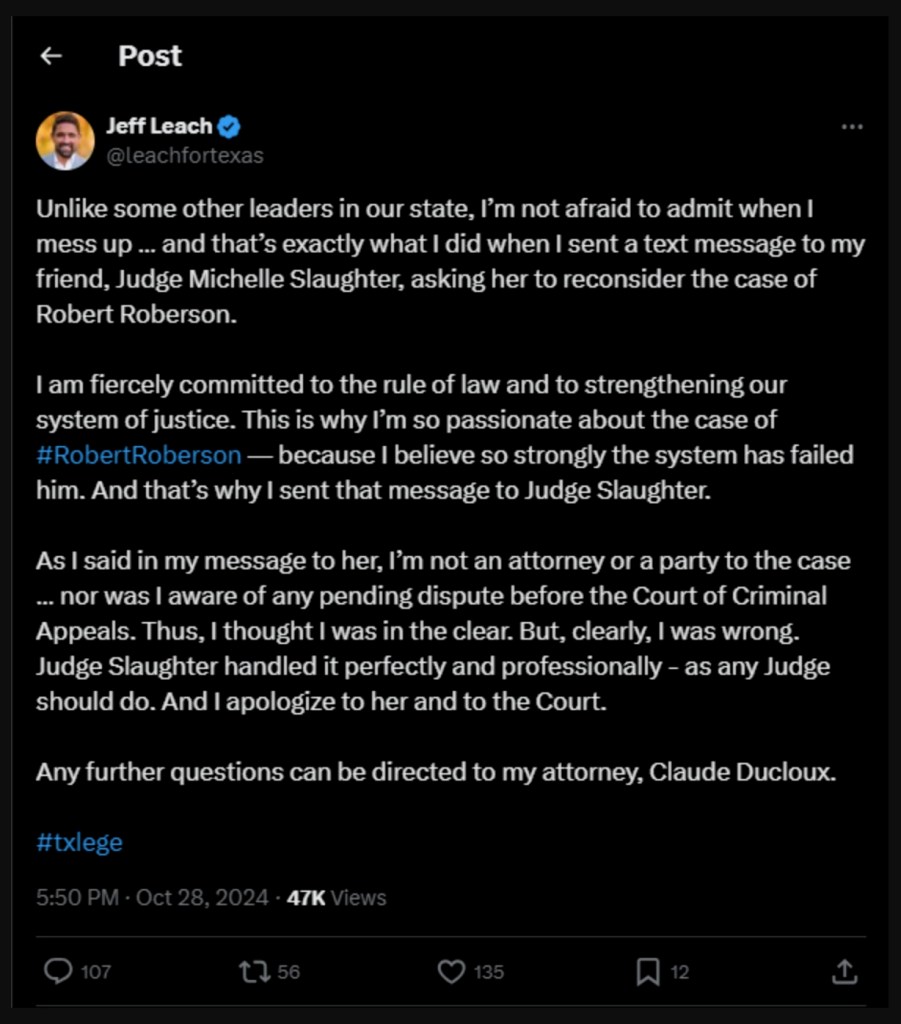
The attorney general’s office has pushed back hard against Robert’s supporters. AG Paxton has called for the resignation of legislator Jeff Leach, who admits to having sent a personal email to a Texas criminal appeals judge on the subject, contrary to the rules for attorneys—his confession to the crime appears in the sidebar of this paragraph.
The legislators are arguing that the state consistently refused to take a second look at Roberson’s case despite the 2013 passage of a “junk science” law, Article 11.073, intended to let prisoners appeal their cases when advances in forensic science raise questions about their convictions. While the Texas law was the first of its kind in the nation, inspiring other states to adopt similar measures, critics maintain that Texas courts have resisted appeals filed under Article 11.073 (Texas Tribune coverage). The legislators say their goal is to look into how the law is being implemented
A Texas Court of Criminal Appeals ordered a new look at Roberson’s case in 2016, based on an Article 11.073 filing. The Innocence Project offers this summary of the proceedings that resulted:
“His case was sent back to the trial court, which conducted a nine-day evidentiary hearing in 2021. There, experts explained that SBS had been discredited and provided compelling evidence that Nikki died of natural and accidental causes. A pathologist testified that Nikki suffered from a severe form of undiagnosed viral pneumonia that has since been more widely understood due to COVID-19. Signs of Nikki’s advanced pneumonia were noted in her autopsy but, at the time, were unexplained. Tragically, unaware of Nikki’s pneumonia, her treating doctors prescribed her with high levels of prescription medication (found in autopsy toxicology results) that are now understood to be deadly in children of Nikki’s age and in her condition. And biomechanical evidence now shows that short falls like Nikki’s can cause severe injury and even death, an explanation for Nikki’s condition that was vehemently rejected by every medical witness who had testified at her trial
“The trial court ignored new evidence from six expert witnesses and rubber-stamped the prosecution’s 17-page proposed findings of fact and conclusions of law, which relied almost exclusively on the outdated scientific evidence introduced at the 2003 trial and conducted when the medical establishment accepted unquestioningly that the triad of intracranial conditions observed in Nikki could be used to ‘diagnose’ shaking and abuse.”
The state Supreme Court, which handles civil cases, is looking only at the jurisdictional dispute.
Meanwhile, three of the five criminal appeals court judges who approved Roberson’s execution in the past are leaving the panel this year, ousted in primary challenges pushed by Paxton. Depending on who is elected to fill those seats, the new court that must approve the execution could become either more or less sympathetic to defense arguments, as detailed by an analysis in the Texas Tribune.
Meanwhile, the public struggle has reignited the debate over shaking theory in the state, national, and international arenas:
- Robert Roberson’s death row case raises questions over capital punishment fairness, Texas Public Radio
- Shaken Baby Has Been Discredited. Why Is Robert Roberson Still on Death Row?, Scientific American (and a follow-up by the same authors, published today, The Law Must Respond When Science Changes)
- Why the Shaken Baby controversy is now stalking death row, Telegraph, UK
An entertaining detail: The first Scientific American op ed listed above includes a quote in the near-final paragraph attributed to pioneering pediatric neurosurgeon Norman Guthkelch, the first person who proposed in print, in 1971, that shaking an infant without impact could cause subural hematoma. The authors report Dr. Guthkelch’s regret that his “friendly suggestion for avoiding injury to children has become an excuse for imprisoning innocent parents.” Although the article doesn’t identify the source of the quote, the highlighted text links to my 2013 posting on this blog, “Dr. Norman Guthkelch, Still on the Medical Frontier,” written after I travelled to interview him in person. The page includes video of key portions of our talk, so I guess the editors gave it the authenticity nod.
June 2025 update: The state has requested a new execution date for Robert Roberson, event though his case is still under appeal, according to KERA news in north Texas.
If you’re not familiar with the debate surrounding SBS/AHT, please see the home page of this blog.
© 2024 Sue Luttner
 On Shaken Baby
Thanks for writing a clear summary of the action – It’s hard to follow all the different angles.
Thank you, Susan, for taking the trouble to follow the action. It’s pretty astonishing.