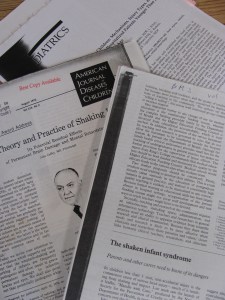
 Child battering entered the national conversation in the early 1960s, when Dr. C. Henry Kempe caught national headlines with his call to arms, “The Battered Child Syndrome”[1].
Over the next decade, in an independent development, auto-safety researchers demonstrated that a rear-end collision could inflict the same brain injuries on a primate, through acceleration alone, as a blow to the head. (See Chapter 11, Whiplash Injury and Brain Damage).
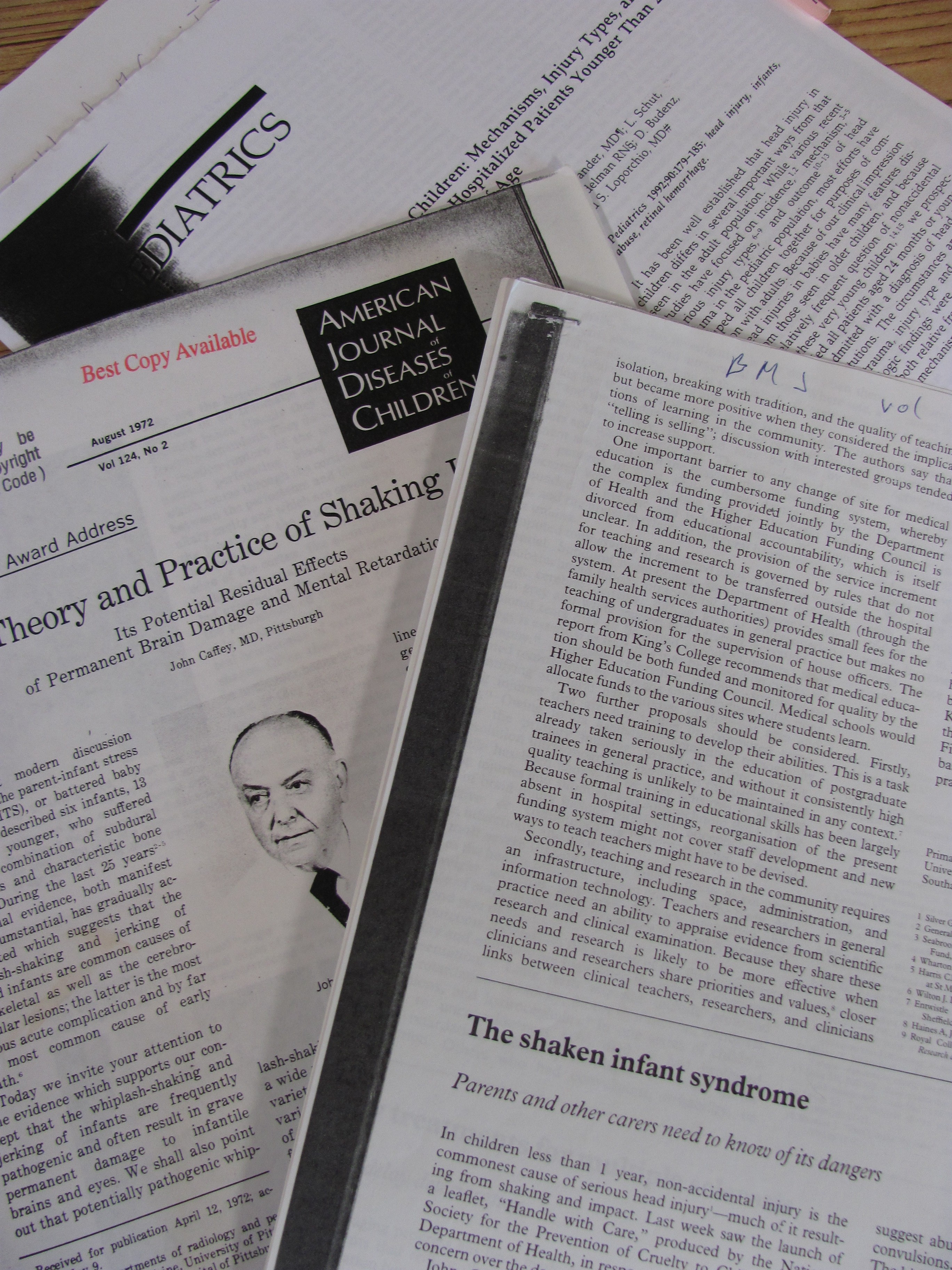
The primate research caught the attention of two doctors who treated children with head injuries, pediatric neurosurgeon Norman Guthkelch[3] in Great Britain and pediatric radiologist John Caffey[2] in the United States. In the early 1970s, first Guthkelch and then Caffey published their propositions that children brought to the emergency room with no bruising, broken bones or other signs of impact, but with the intracranial findings associated with battering, could be suffering the effects of a violent shaking. Testing the hypothesis was impossible, but the papers were widely read and the model was soon accepted on both sides of the Atlantic.

From the Journal of Neurosurgery, March, 1987, Vol. 66, pp 409–415
In the 1980s, though, biomechanics researchers applying their techniques to shaken baby theory found that human subjects couldn’t shake infant dummies hard enough to reach projected thresholds for bursting the necessary blood vessels.[4] When the scientists added impact, however, angular accelerations spiked, and the team concluded that shaking victims were most likely thrown down afterward, possibly onto a soft surface like a mattress. Additional biomechanical studies confirmed this work[5] and a few researchers added another critique: The hypothesized forces should also break the child’s neck, not a usual finding in SBS cases.[6] These papers, however, had little impact on the model of shaking generally presented in the courtroom.
The American Academy of Pediatrics (AAP) published its first position paper on infant shaking in 1993, and has since revised it twice as the field has evolved. The original version emphasized the murky nature of the condition, and specifically said that the symptoms might evolve over time:
Shaken baby syndrome is characterized as much by what is obscure or subtle as by what is immediately clinically identifiable. A shaken infant . . . may have a history of poor feeding, vomiting, lethargy, and/or irritability occurring intermittently for days or weeks prior to the time of initial health care contact.… The comatose state may be unrecognized by caretakers and even by some medical providers who may assume that the infant is sleeping or lethargic[7].
Into the Headlines
SBS hit the public consciousness in 1997, when 19-year-old British au pair Louise Woodward, the “Boston nanny,” was accused of shaking her 8-month-old charge to death. The defense argued that an older brain injury had started rebleeding while the boy was in the nanny’s care; the prosecution insisted he had suffered a violent shaking immediately before his collapse.
After a televised trial, the jury convicted Woodward of second degree murder. Judge Hiller Zobel reduced the charge to manslaughter, however, and set the sentence to time served, sending Woodward back to a heroine’s welcome in England.
Unhappy with that outcome, 70 child-abuse doctors published a letter in Pediatrics, the journal of the AAP, dismissing the rebleed theory as a “courtroom diagnosis” and decrying news coverage that treated it as credible[8]. That letter articulated the “triad,” the three symptoms that define the syndrome:
The shaken baby syndrome (with or without evidence of impact) is now a well characterized clinical and pathological entity with diagnostic features in severe cases virtually unique to this type of injury—swelling of the brain (cerebral edema) secondary to severe brain injury, bleeding within the head (subdural hemorrhage), and bleeding in the interior linings of the eyes (retinal hemorrhages). Let those who would challenge the specificity of these diagnostic features first do so in the peer-reviewed literature, before speculating on other causes in court.
With significantly less attention from the media, a forensic pathologist in Hastings Minnesota, Dr. John Plunkett, took on the challenge, publishing a pathology article that questioned everything about SBS, from the plausibility of the model to the timing of the symptoms[9]:
Objective evidence strongly suggests that we should abandon the term “shaken-infant syndrome” or “shaken-slammed infant syndrome”… and admit that we do not know the force required to cause the injury. We must recognize that “retinal hemorrhage,” regardless of its characteristics, is at best an external marker for a probable head injury. Our testimony needs to acknowledge that there are very limited data regarding a lucid interval in a child following rotational head injury, and that the concept of diffuse axonal injury may not explain why some children die very quickly after an injury whereas others appear to have a symptom-free or relatively symptom-free interval prior to death
 Timing of the Injuries
The case that drew me into this project had hinged on expert testimony that the effects of a violent shaking always appear immediately after the assault: A friend’s niece had been convicted because she was watching an infant at the time the tell-tale seizures and breathing problems started. At the hospital, doctors had found not only new bleeding inside the child’s skull but also old blood, evidence of a previous brain injury, suffered at least days before the child’s collapse at the babysitter’s. I had gone to the medical library looking for the research that proved immediate symptoms in all cases—but what I’d found before I got that far was an argument about the entire concept.
So I settled in for a broader review of the literature, keeping an eye out for the research on timing.
In 2001, then, I was intrigued to see the updated AAP statement on SBS[10], which removed the language about subtlety, instead calling SBS a “clearly definable medical condition,” and made an important change in its position on timing[11]. Although the new statement included the sentence about a long history of poor feeding and so on, the next sentence proposed that parents should recognize an immediate change in their child after a shaking assault:
A victim of sublethal shaking may have a history of poor feeding, vomiting, lethargy, and/or irritability occurring intermittently for days or weeks. These clinical signs of shaken baby syndrome are immediate and identifiable as problematic, even to parents who are not medically knowledgeable.[12]

From the New England Journal of Medicine, June 18, 1998, Vol. 338, No. 25, 1822–1829
The footnoted citation for this new advice was a “Current Concepts” column in The New England Journal of Medicine[13]. The paper was not original research, but a status report assembled by a respected team led by pediatric neurosurgeon Dr. Ann-Christine Duhaime, the lead author on the 1987 biomechanical study that cast doubt on shaking theory. The 1998 review reiterated the opinion that impact was part of the “usual mechanism” in these injuries[14] and also endorsed the assumption of immediate symptoms. The discussion on timing opened:
Since the history is often unreliable in cases of the shaking-impact syndrome, information about the timing of the injury must be extrapolated from data on accidental trauma…[15]
and concluded:
…Thus, an alert, well-appearing child has not already sustained a devastating acute injury that will become clinically obvious hours to days later [16].
This line of reasoning sounded plausible enough, but I did not think it came close to reasonable scientific proof that the symptoms of a violent shaking are immediately obvious in all cases—especially in children with pre-existing brain injuries, like the infants in the care of Louise Woodward and my friend’s niece.
The NEJM column, however, explicitly rejected the possibility of “a sub-clinical injury that is later exacerbated by a relatively minor second mechanical trauma,”citing literature from sports-injury medicine[17]:
This pattern of injury, with a clear time line and rapid, well-described acute deterioration, stands in sharp contrast to the vague histories of previous episodes of trivial trauma that are sometimes suggested as possibly causative in the shaking-impact syndrome[18].
By the late 1990s, then, despite the lack of clear scientific support, most experts seemed to agree: The symptoms of a violent shaking assault are immediate and obvious in all cases.
New Doubts
But then, in September of 1999, forensic pathologist Dr. Robert Huntington III performed the autopsy on a toddler who had arrived at the hospital in the morning with symptoms of nausea and lethargy, described as “fussy and clingy, but interactive and responsive.” She was treated for gastro-intestinal illness. Only when the child quit breathing later that night did the staff realize she had entered the hospital with a brain injury.
Three years earlier, Dr. Huntington had testified to immediate symptoms in the trial of Audrey Edmunds, an infant care provider convicted of shaking a baby to death. After performing the 1999 autopsy, then, he wrote the letter that appears on the home page of this site, reporting that he had seen a documented case of slowly evolving symptoms following an infant head injury.

Forensic pathologist John Plunkett, at an Innocence Network meeting
When John Plunkett saw Dr. Huntington’s letter, he says, he called his colleague and asked him, “What are you going to do about Audrey Edmunds?”
“Yes,” Huntington reportedly sighed, “What are we going to do about Audrey Edmunds?”
Ultimately, Plunkett gave Huntington’s letter to Keith Findley at the Wisconsin Innocence Project, which took up Audrey’s case. In 2007, a circuit court heard not only from Huntington about his personal experience with delayed symptoms but also from Plunkett and several other SBS critics, including pediatric neuroradiologist Dr. Patrick Barnes, who had testified for the prosecution in the Woodward trial but later become convinced that the classic SBS model was wrong. The circuit court denied Findley’s motion for a new trial, but after reviewing the transcripts, an appeals court reversed that decision, freeing Ms. Edmunds after 11 years in prison. The decision recognized a “shift in mainstream medical opinion” about SBS and specified:
It is the emergence of a legitimate and significant dispute within the medical community as to the cause of [the infant’s] injuries that constitutes newly discovered evidence.

Deborah Tuerkheimer, from the De Paul University College of Law web site
That reversal drew the attention of Professor Deborah Tuerkheimer at DePaul College of Law, herself a former child-abuse prosecutor. As I’d done a few years earlier, Tuerkheimer started researching SBS and was drawn into the arena by what she found: an unproven theory that entered the courtroom before it was confirmed. She has now written two law-review articles and an op ed piece in the New York Times, in which she argues that hundreds of innocent people have been convicted of shaking infants over the past three decades.
In the wake of the Edmunds decision, Innocence Projects across the country have started examining shaking cases, and the Downstate Illinois Innocence Project has filed an appeal in the case of infant care provider Pamela Jacobazzi, convicted in 1999.
In 2009, the AAP published its third statement on SBS, explicitly removing “shaking” from the name and defining the condition instead as Abusive Head Trauma (AHT), with this explanation:
Legal challenges to the term “shaken baby syndrome” can distract from the more important questions of accountability of the perpetrator and/or the safety of the victim. The goal of this policy statement is not to detract from shaking as a mechanism of AHT but to broaden the terminology to account for the multitude of primary and secondary injuries that result from AHT, some of which contribute to the often-permanent and significant brain damage sustained by abused infants and children.[19]
The 2009 statement recommended preserving the well-known name—shaken baby syndrome—for prevention campaigns:
Just as the public commonly uses the term “heart attack” and not “myocardial infarction,” the term “shaken baby syndrome” has its place in the popular vernacular. However, for medical purposes, the American Academy of Pediatrics recommends adoption of the term “abusive head trauma” as the diagnosis used in the medical chart to describe the constellation of cerebral, spinal, and cranial injuries that result from inflicted head injury to infants and young children.[20]
At the Eleventh National Conference on SBS, held in the fall of 2010 in Atlanta, Georgia, Dr. Duhaime emphasized the need for more research on infant head trauma and the importance of keeping an open mind. “What I would propose,” she opened, “is that the scientific method is a form of dialog in which you must be willing to be changed by your investigation.” Research is a never-ending cycle of revising your hypotheses, she said, “which is very frustrating for people who want an answer and want it now.”
But Dr. Duhaime was a rare voice of moderation at the conference. More than one keynote speaker rejected the work of Plunkett and Tuerkheimer, accusing them of grandstanding for money and fame. A pediatric neurosurgeon complained, “It’s a pretty lucrative deal to attack head trauma,” and one attorney read court testimony from defense experts while Pinocchio’s nose grew on the screen behind him. AAP president-elect Dr. Robert Block mocked the idea of “the triad,” which he characterized as a term used by the defense to discount the complexity of the diagnosis. “Only people who are not active physicians working with children,” he said, “naïve journalists, and professors with a biased agenda would propose that only three signs and symptoms support a diagnosis.”
I think the acrimony of this debate has caused a serious breakdown in communication. I do hope we can resolve this tragedy with dignity.
I also hope you find the story as compelling as I do.
© 2011 Sue Luttner
[1] Kempe C., Silverman FF, Steele B., Droegemueller W, Silver H. “The Battered-Child Syndrome,” Journal of the American Medical Association, July 7, 1962, Vol. 181, No. 1, 17–24.
[2] Caffey J. “On the Theory and Practice of Shaking Infants,” American Journal of the Diseases of Childhood 1972; 124:161-169
[3] Guthkelch, AN “Infantile Subdural Hematoma and Its Relationship to Whiplash Injuries,” British Medical Journal,1971;2:430–431.
[4] Duhaime SC, Gennarelli TA, Thibault, L., Bruce DA, Margulies SS, Wise, R. “The shaken baby syndrome: A Clinical, pathological, and biomechanical study,” Journal of Neurosurgery, March, 1987, Vol. 66, pp 409–415.
[5] Prange MT, Coats B, Duhaime, AC, Margulies S, “Antrhopmorphic silulations of falls, shakes, and inflicted impacts in infants,” Journal of Neurosurgery, July, 2003, Vol. 99, 143–150.
[6] “Bandak FS. “Shaken baby syndrome: A biomechanics analysis of injury mechanisms,” Forensic Science International 151 (2005) 71-79.
[7] Shaken Baby Syndrome: Inflicted Cerebral Trauma,” Pediatrics, Vol. 92, No. 6, Dec. 1993, pp 872-3.
[8] Letter to the editor, “Shaken Baby Syndrome—A Forensic Pediatric Response,” Pediatrics, February, 1998 Vol. 101, No. 2
[9] Plunkett, J, “Shaken Baby Syndrome and the Death of Matthew Eappen: A Forensic Pathologist’s Response,” American Journal of Forensic Medicine and Pathology, 1999 Vol. 20, No. 1, 17–21
[10] AAP Committee on Child Abuse and Neglect, “Shaken Baby Syndrome: Rotaional Cranial Injuries—Technical Report,”Pediatrics, July 2001, Vol. 108, No. 1, 206–209
[13] Duhaime, A, Christian, CW, Rorke, LB, Zimmerman, RA, “Nonaccidental Head Injury in Infants—The ‘Shaken Baby Syndrome,’” New Eng J of Med, June 18, 1998, Vol. 338, No. 25, 1822–1829
[17] Kelly JP, Nichols JS, Filley CM, Lillehei KO, Rubinstein D, Klein- schmidt-DeMasters BK. Concussion in sports: guidelines for the preven- tion of catastrophic outcome. JAMA 1991;266:2867-2869
Cantu RC. Cerebral concussion in sport: management and prevention. Sports Med 1992;14:64-74
[18] Duhaime A, Christian CW, Rorke LB, Zimmerman RA, “Nonaccidental Head Injury in Infants—The ‘Shaken Baby Syndrome,’” New Eng J of Med, June, 1998, Vol. 338, No. 25, 1825
[19] Christian CW, Block R, and the Committee on Child Abuse and Neglect, “Abusive Head Trauma in Infants and Children,” Pediatrics, Vol. 123, No. 5, May 2009, 1410

 An editorial this week by a pathologist in Durango, Colorado, has alerted me to another way a life can be destroyed by a misdiagnosis of infant shaking.
 A Texas Update








 On Shaken Baby