
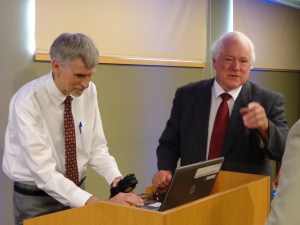
Drs. John Galaznik and John Plunkett, at the EBMSI conference
Evidence-based medicine (EBM) is a formal discipline intended to sort out what doctors really know from what they simply believe, “to differentiate objective data from opinion,” explained forensic pathologist Dr. John Plunkett at the second Evidence Based Medicine and Social Investigation conference earlier this month. “Evidence should always trump opinion,” he noted.
As detailed below, the EBM movement relies more on scientifically controlled research—and less on expert opinion and case studies—than the approach that’s traditionally dominated the medical literature.
The highest level of certainty under EBM guidelines applies more readily to drug trials, Plunkett said, where researchers can use large populations and appropriate controls, than to shaken baby syndrome research. “Nothing in the child-abuse literature is going to come anywhere near to Level I,” he conceded, on either side of the shaking debate. “There is not going to be a major bulletin about this.”
The arena itself constrains researchers’ ability to study infant head trauma, Plunkett said, and so the results are not reliable, with the exception of “the biomechanical studies that have been repeated over and over with the same results”—that is, that shaking without impact should not cause subdural hematoma.
Plunkett said he himself misunderstood the role of rotation for many years, even after he started doubting classic shaking theory in the 1980s. “I had been taught that rotation causes subdural hematoma, so I was looking for rotation in a fall,” he explained. “I didn’t realize it until 13 years ago: Impact causes rotation.”
A number of test-dummy videos shown during the conference illustrated his point: When a dummy’s head hit the floor, it would bounce back up, in an arc constrained by the neck, finally hitting the floor again at least once.

Rotational motion resulting from linear impact, from F.A. Bandak, Forensic Science International, 151 (2005) p. 75
Biomechanical engineers use the term “impulse loading” to describe the rotational forces caused by the head’s motion at the end of its tether, that is, the neck, which is attached to the trunk.
“Everything caused by impulse loading can be caused by impact,” Plunkett declared. “The reverse in not true.” While impact can cause subdural hematoma, retinal hemorrhage, and encephalopathy, for example, shaking cannot cause skull fracture.
There is simply no need to presume shaking, he said, when a child with the triad shows evidence of an impact.
Nor is shaking necessary to explain subdurals when the child shows no evidence of impact, because “Subdural collections occur without trauma.” A number of metabolic and infectious diseases can cause them, as well as vascular malformations and any interruption of oxygen to the brain. Some causes, like Saggittal Sinus Thrombosis, are easy to diagnose, Plunkett said, but “Superficial Cortical Venous Thrombosis is routinely missed.”
He dismissed ruptured bridging veins as the source of small subdural hematomas, the “thin film” hematomas often associated with a shaking diagnosis. “Bridging veins are large-caliber conduits,” he said, carrying 5 to 10 ml. of blood per minute. “If one of these things is ruptured, you’re going to get a lot of bleeding, and you’re going to get it really fast.” He described stretch tests in which researchers were able to suspend 4 ounces—the equivalent of a stick of butter, which represents about 500 pounds per square inch—from a harvested bridging vein without snapping it.
“How do you break those without impact?” he asked, answering himself: “You don’t.”
When faced with the triad and no clear explanation, Plunkett concluded, “The default diagnosis is ‘I don’t know,’ not ‘Abusive Head Trauma.'”
Evidence-based medicine guidelines vary in different places and contexts, but the U.S. Preventive Services Task Force defines these levels of reliability for published medical literature (from Wikipedia):
- Level I: Evidence obtained from at least one properly designed randomized controlled trial.
- Level II-1: Evidence obtained from well-designed controlled trials without randomization.
- Level II-2: Evidence obtained from well-designed cohort or case-control analytic studies, preferably from more than one center or research group.
- Level II-3: Evidence obtained from multiple time series with or without the intervention. Dramatic results in uncontrolled trials might also be regarded as this type of evidence.
- Level III: Opinions of respected authorities, based on clinical experience, descriptive studies, or reports of expert committees.
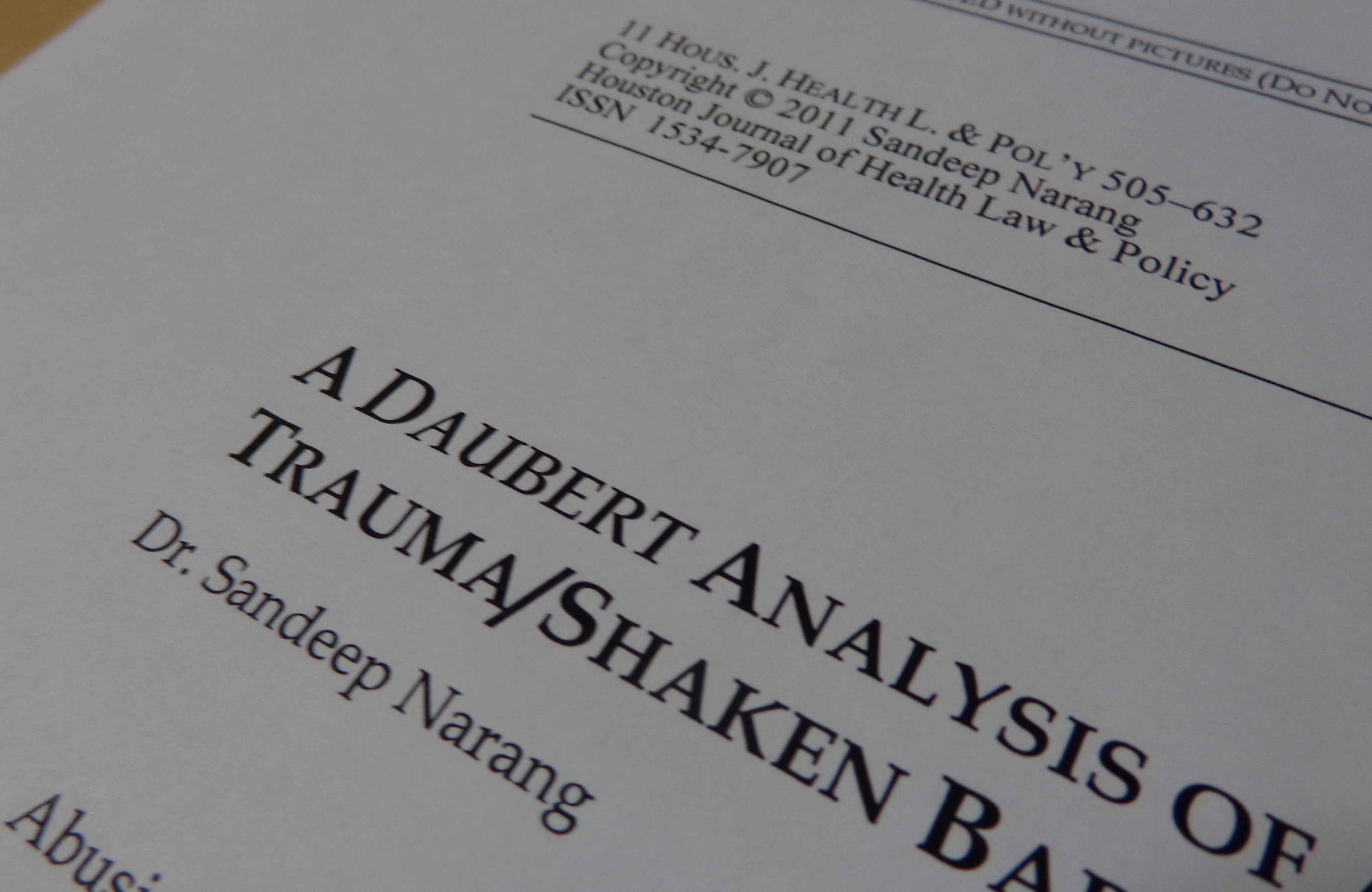
The bulk of the child abuse literature is at Level III on this scale. For an evidence-based analysis of the medical literature about shaken baby syndrome, please see this journal article by Dr. Mark Donohoe.
If you are not familiar with the debate surrounding shaken baby syndrome, please see the home page of this site.
-Sue Luttner













 On Shaken Baby