Innocent Family Petition Hits a Nerve

Geers twins

Geers twins

When child protective services separated Melissa and Anthony Geers from their five sons last spring, Melissa says, the pain was staggering. The worst part was watching the effects on their children: the 9-year-old’s full-blown panic attack, the 8-year-old’s holding his mom “so tight I couldn’t breathe,” the sudden interruption of breast-feeding for the 4-month-old twins (Melissa pumped throughout their foster placement).

The state filed to terminate the Geers’ parental rights just weeks after x-rays revealed rib fractures in both twins—but withdrew the suit 10 weeks later, after the Geers submitted opinions from eight outside experts who attributed the fractures to fragile bones, citing two underlying causes: First, the boys had a metabolic disorder that impedes bone formation. Second, like most twins, the youngest Geers had arrived early, 7 weeks early in their case. Because the rate of bone mineralization ramps up during the final trimester of gestation, premature infants in general are prone to weak bones.

photo by Doug Smith, Washtenaw Watchdogs

Anthony & Melissa Geers. Photo by Doug Smith, Washtenaw Watchdogs

But those explanations entered the record only because the Geers did their own research and called in their own experts. The state tore her sons’ lives apart, Melissa says, based on the opinion of one child abuse doctor “who never met me, my husband, or our kids.”

“We have two sons, now 10 and 8, who were traumatized by this experience,” she points out. “They don’t do the things they used to do. They are afraid. The child abuse experts need to understand what they are doing to children.”

Since their story hit the news, Melissa says, they have been contacted by an astonishing number of families with their own stories of ill-considered abuse diagnoses—most of them with far less happy outcomes. “How are the child abuse doctors not aware of all these other things?” Melissa asks. “That’s the part that bothers me the most. Why are they not doing their due diligence?”
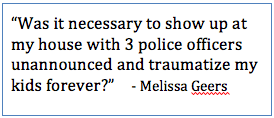
GeersQuoteThe Geers say they understand how valuable it was to have a supportive community during their ordeal, as documented by Click on Detroit and later by Melissa herself in an essay on Medical Kidnap. Melissa says she and her husband now feel compelled to do what they can to shed light on a broken system. Earlier this fall, the Geers joined demonstrators at the University of Wisconsin Board of Regents meeting, where supporters of Joshua and Brenda Burns protested the Burns family’s treatment by the university’s Mott Children’s Hospital. As reported on this blog in the spring, the Burnses’ daughter Naomi was diagnosed as a shaken baby at Mott in 2014. While Naomi seems to have recovered fully, Joshua is serving a one-year sentence in the county jail. As he approaches his December release date, Joshua had been granted weekly visits with his family, through a glass window and a telephone handset, after a year and a half of no contact at all with Naomi—but those visits were cancelled after the first one. (For an insider’s view of the regents meeting, including video statements by Melissa Geers and Brenda Burns, please see the Washtenaw Watchdogs coverage.)

Accused father Andrew Sprint

Accused father Andrew Sprint

The Burns family and the Geers family found each other, and they also found the Protecting Innocent Families (PIF) petition, which calls for an objective, scientific review of the evidence base underlying today’s guidelines for diagnosing child abuse. The petition form includes an optional field where signers can identify the name of a defendant or family they are supporting. Of about 2,700 people who have signed the petition so far, slightly more than 1,000 have filled in the support field. The signers have named 338 individuals and families. The most frequently named case, with 270 signatures, is the Burns family, the subject of the Torn Family web site, which includes a link to the petition. The Geers family is the second most-often named, with 96 signers, presumably from their Facebook site.

Other defendants named in significant numbers were a mix of past cases that helped inspire the petition—like the stories of Kristian Aspelin, Brian Peixoto, Tiffany Cole-Calise, Amanda Brumfield, and Leo Ackley—and unfolding cases like those of Rebecca and Anthony Wanosik and Cynthia and Brandon Ross, reunited with their children this summer; Cindy Rosenwinkel, convicted in 2015; and single father Andrew Sprint, who declared his innocence outside the Children’s Justice Conference this past spring in Seattle.

GeersQiuoteWhen PIF launched the petition in March of 2015, the immediate goal was to collect the names of 1,000 people who had seen a medical misdiagnosis of child abuse tear apart an innocent family. Three weeks after the petition went live, 1,000 people had signed and signatures were still coming in. The rate has slowed since then, but new names continue to arrive, and PIF has decided to launch another publicity campaign before implementing its labor-intensive plan for taking the petition to Congress. Signers who indicated they would be willing to contact Congress personally should expect to be hearing from PIF volunteers.

In addition to calling for a review of the scientific literature, the petition objects to the suppressive tactics used by the state and by professional organizations. Both families and professionals feel extraordinary pressure, the petition argues:

Even when charges are dismissed, caretakers acquitted, or verdicts overturned, families are emotionally and financially devastated, with many unwilling to speak out because they are still traumatized or they fear stigma or retaliation. Doctors and other experts who question or criticize these diagnoses also suffer retaliation, including threats against their jobs and licenses.
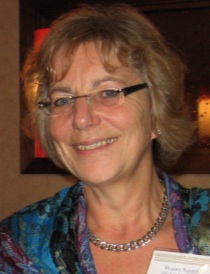
Dr. Waney Squier

Right now in England, for example, neuropathologist Dr. Waney Squier is facing hearings by the General Medical Council, where she is accused of testifying “outside her field of expertise,” giving biased opinions, and not paying “due regard to the views of other experts.” Last fall, The Telegraph reported that the original complaints against Dr. Squier came from the Metropolitan Police, who were tired of losing shaken baby cases because of her testimony on behalf of accused parents.

Dr. Squier has long been the target of direct and indirect harassment from her opponents. As reported in 2012 on this blog, a fictional character with a curriculum vitae remarkably like Dr. Squier’s confessed on the BBC program Silent Witness to having conducted her research using illegally harvested infant brain tissue. In fact, the real Dr. Squier had been readily cleared when the same accusations were levied against her—and some observers suspect those accusations were merely a ploy to keep her out of the courtroom during the resulting investigation.

Dr. John Plunkett

Dr. John Plunkett

In the U.S. in the early 2000s, forensic pathologist Dr. John Plunkett was forced to defend himself against charges that he lied under oath after he testified on behalf of an Oregon defendant in a child head injury case. In “The Battle of the Expert,” ABA Journal reporter Mark Hansen traced the byzantine course of the case against Dr. Plunkett, which ended with an acquittal in 2005.

Drs. Squier and Plunkett have also brought their criticisms of shaking theory into the medical journals. When Dr. Squier and her colleagues proposed an alternative to torn bridging veins as the source for thin-film subdural hematomas in 2009, their ideas were dismissed, but their model is now finding acceptance by doctors on both sides of the debate. Still, instead of considering the reasoned objections of their critics, some proponents of shaken baby theory demonize defense experts at conferences and in the press. After charges were dropped against Irish nanny Aisling Brady McCarthy earlier this fall, for example, Kevin Cullen at The Boston Globe quotes Dr. Eli Newberger calling shaken baby critics “defense whores”:

Newberger is dismissive of the revisionist views that defense attorneys are increasingly tapping.

“On the clinical testifying roster are a whole lot of people who will cut their consciences for money,” Newberger said. “They’re hired out as defense whores. I just find this vile.”

The Protecting Innocent Families petition is an effort to bring together the many people who are affected by misguided diagnoses of child abuse, including the accused families, their extended communities, and the medical and legal professionals who defend them.

If you agree that we need an objective, scientific review of the evidence base for today’s guidelines for diagnosing child abuse, please sign the petition, at http://bit.ly/InnocentFamilyPetition. If you have a web site or Facebook page, please post the  url. If you are a medical or legal professional, please consider sharing the url with your colleagues and clients (that’s http://bit.ly/InnocentFamilyPetition).

A number of individuals and families not mentioned above have also received quite a few votes of support, including Angela and Danny Frasure, Cor and James Thompson, Andrew Valdez, Megan Griffin, Marsha Mills, Rachel and Gourab Sahoo, Kacie and Raymond Hernandez, and a handful of people who would rather not be named publicly.

copyright 2015, Sue Luttner

If you are not familiar with the debate surrounding shaken baby syndrome, please see the home page of this site.
4 Comments

Filed under abusive head trauma, AHT, parents accused, SBS, shaken baby syndrome

Retro Report Nails the Nanny Story

Louise Woodward, 1997

Louise Woodward, 1997

Retro Report producer Miriam Weintraub, in her recent documentary looking back at the story of “Boston nanny” Louise Woodward, has identified the key fact about news coverage of the case in the 1990s: In its fixation on working parents and teenage nannies, the press missed the real story, the actual medical debate about shaken baby theory.

“But today the shaken baby diagnosis is under increasing scrutiny,” the narrator informs us, cutting to a quote from Dr. Patrick Barnes:

“There is no doubt that errors have been made and injustices have resulted.”

Dr. Barnes, a pediatric neuroradiologist, testified for the prosecution at the Woodward trial but later began doubting what he’d learned from his mentors and peers about infant head injury, as he explains on camera:

“Particularly when I started going to the literature outside of the box I was in, in the child abuse literature box, and looking at the science of traumatic head injury written by true specialists and experts in those fields. Then I began to be concerned that for the prior 15-20 years I may be wrong.”

Prosecutor Martha Coakley, however, stands by the conviction and the diagnosis:

We knew that the injuries this child had suffered, given that he was fine that morning and by the time he was in the emergency room he was on death’s door, those had been inflicted injuries. They were severe, they were acute and they were not accidental.

And Dr. Robert Block, past president of the American Academy of Pediatrics (AAP), says there has been no change in thinking among child abuse experts:

There are a few people who have generated opposing points of view for whatever reason. But, if you talk to child abuse pediatricians who work with these clinical cases all the time you will find that opinion about the presence of shaken baby syndrome or abusive head trauma has not shifted one iota.

At the time of the Woodward trial, the official name of the diagnosis was still Shaken Baby Syndrome (SBS), as described in both the 1993 AAP position statement and the 2001 AAP technical report. By the time Dr. Block was interviewed by Retro Report in 2015, the AAP had issued its 2009 update, changing the name to Abusive Head Trauma (AHT) with this explanation:

“The term ‘shaken baby syndrome’ has become synonymous in public discourse with AHT in all its forms.17 The term is sometimes used inaccurately to describe infants with impact injury alone or with multiple mechanisms of head and brain injury and focuses on a specific mechanism of injury rather than the abusive event that was perpetrated against a helpless victim. Legal challenges to the term ‘shaken baby syndrome’ can distract from the more important questions of accountability of the perpetrator and/or the safety of the victim.”

I recommend following the link from this quote to the abstract for footnote 17, Lazoritz and Baldwin (1997), “The whiplash shaken infant syndrome: Has Caffey’s syndrome changed, or have we changed his syndrome?,” which documents how far the diagnosis had strayed in 1997 from Caffey’s first definitions. Following some of the further links on that page, to the abstracts for Bandak 2005 (“Shaken baby syndrome, a biomechanics analysis of injury mechanisms”), for example, and Talbert 2009  (“The nature of shaken baby syndrome injuries and the significance of the ‘lucid interval’), illustrates some of the unresolved questions about the condition.

The Retro Report narration identifies the traditional triad as the defining features of shaken baby syndrome at the time of the Woodward trial:

“For decades, when doctors saw a child with a particular set of symptoms known as the triad—bleeding behind the eyes, bleeding on the brain, and brain swelling—they would conclude there was only one possible cause: shaking.”

But Dr. Block says doctors do not rely on the triad:

“Nobody looks at a baby with those three things and says, ah ha, shaken baby syndrome… We go through a very intensive history taking, which involves looking at the last 24 to 48 hours of this baby’s life. And then we do what’s called a differential diagnosis after doing a bunch of laboratory tests. Our job is to make sure that we’ve looked at every other possibility.”

As this blog has reported before, however, in 1998 several dozen child abuse experts signed a letter about the Woodward case that took this position:

The shaken baby syndrome (with or without evidence of impact) is now a well-characterized clinical and pathological entity with diagnostic features in severe cases virtually unique to this type of injury—swelling of the brain (cerebral edema) secondary to severe brain injury, bleeding within the head (subdural  hemorrhage), and bleeding in the interior linings of the eyes (retinal hemorrhages). Let those who would challenge the specificity of these diagnostic features first do so in the peer-reviewed literature, before speculating on other causes in court.

Dr. Block’s parting quote explains his priority in the shaken baby debate:

I think it’s reasonable to worry and be as careful as we can to make sure that people who are convicted are appropriately convicted. But to talk about their conviction negates the fact that we really need to be talking about the children. It’s the children who are affected in each and every case. It’s the children who are devastated or killed.

Quentin Stone

Quentin Stone

The Retro Report documentary also features the case of Quentin Stone in Yolo County, California, who was found innocent by a jury in May of 2014 but is still fighting in family court for reunification with his wife and two surviving sons. “I don’t think there’s really a way to explain what it feels like to lose your entire family,” Stone tells the interviewer.

The Retro Report posting was published in conjunction with a New York Times article by Clyde Haberman that includes two additional short videos, a “mini-doc” featuring professor Adele Bernhard from the Pace Law School Post-Conviction Project talking about the René Bailey case, and an interview with pioneering pediatric neurosurgeon Dr. A. Norman Guthkelch, the first person to propose in print that shaking an infant could cause subdural hematoma.

Melissa Calusinski

Melissa Calusinski

In other shaken baby news, the lawyer for convicted day care worker Melissa Calusinski in Illinois has made a small step toward a possible appeal. According to the Chicago Tribune, a judge is considering attorney Kathleen Zellner’s motion for a hearing on what she says is new x-ray evidence in the case. Earlier this week, the judge gave the state 90 days to respond to Zellner’s request. Calusinski’s case moved to the national stage this past winter, when a 48 Hours report, “Blaming Melissa,” raised questions about the evidence and the interrogation that led to a confession she later recanted. Tribune reporter Lisa Black published this article in June about the current motion and the possible new evidence.

3 Comments

Filed under abusive head trauma, AHT, SBS, shaken baby syndrome

Aisling Brady McCarthy Released, a Decision That Will Matter

Aisling Brady McCarthy, from The Boston Globe coverage

Aisling Brady McCarthy, from The Boston Globe coverage

Last week’s decision in Boston to drop charges against Irish babysitter Aisling Brady McCarthy, now free after two and a half years in jail awaiting trial in the death of 1-year-old Rehma Sabir, seems to have produced only a few ripples in the news, but I think the case will stand as a touch point in the ongoing debate about shaken baby.

The Middlesex County District Attorney dropped the charges against McCarthy after the medical examiner reviewed the evidence and amended the child’s autopsy report, changing the cause of death from “homicide” to “undetermined.” The move validated years of dogged filings by McCarthy’s defense attorneys, Melinda Thompson and David Meier, who had argued from the beginning that the shaking diagnosis was made without considering Rehma’s complex medical history, including a likely bleeding disorder.

A press release from the district attorney’s office quotes the medical examiner:

In particular the overall state of Rehma’s health and her past medical issues raise the possibility that she had some type of disorder that was not able to be completely diagnosed prior to her death.

Even the in-depth coverage of the story focused on the problems with this particular case, not the larger debate about the diagnosis, while most news reports stopped at McCarthy’s personal story and her joyful welcome in Ireland, and some treatments seemed intent on shoring up historical opinion. Boston’s public radio station WBUR, for example, broadcast an interview with Dr. Robert Sege, a member of the American Academy of Pediatrics committee on child abuse and neglect, who was asked about the implications of this story and a recent rash of successful appeals:

To me, it doesn’t raise the question at all. If you think about it, there are people who are falsely accused of murder, robberies, all kinds of things and the justice system is not perfect. So in a situation where we have hundreds and perhaps a thousand infants a year who experience shaken baby syndrome, the fact that 16 convictions over a multi-year period were overturned lets me know that the justice system worked, and that people get a fair shot at getting their story told.

WBUR also ran an interview with Dr. Shannon Carpenter, a bleeding disorder expert who seemed to think that McCarthy really is guilty. The reporter paraphrased Dr. Carpenter as saying:

[S]adly, no, there’s no kinder explanation here: Abusive head trauma — a better term than “shaken baby syndrome” because abuse can involve more than shaking — is far more common than serious bleeding disorders.

and offered this direct quote:

“While anything is possible, you have to look at what’s probable and what other patients have experienced. And patients with bleeding disorders are not immune to trauma, whether it’s inflicted or non-inflicted.”

So much for innocent until proven guilty.

middlesexCountyCourthouse

Middlesex County Courthouse

Still, both Boston television station WCVB and letter writer Phillip L. Radoff in The Boston Globe noted that McCarthy’s case is the second Middlesex County shaken baby prosecution to be dismissed in the past year—charges were dropped in September of 2014 against local father Geoffrey Wilson. Both diagnoses were made by child abuse pediatrician Dr. Alice Newton, who presented at the National Center on Shaken Baby Syndrome conference in Denver last fall, on the topic, “Towards Better Collaboration Between District Attorneys and Child Abuse Pediatricians.” Her abstract for that talk includes this reflection:

With an increasing focus in our society on whether Abusive Head Trauma exists, close collaboration between medical professionals and law enforcement has become increasingly important for a successful investigation and prosecution.

What I find refreshing about Dr. Newton’s abstract is the full transparency: She seems to believe that the debate really is about whether or not Abusive Head Trauma exists, and she recommends that child abuse pediatricians view themselves as part of the prosecution team.

Meanwhile, Katherine Judson and Keith Findley at the Wisconsin Innocence Project wrote a letter to the editor of The Boston Globe praising the Middlesex medical examiner’s office for its willingness to re-think the McCarthy case and offering this bold—and accurate—indictment of the community of child abuse experts:

Even after nearly 20 reversals of convictions and hundreds of dismissals and acquittals, some proponents of the shaken baby syndrome and abusive head trauma hypothesis refuse either to acknowledge that there may be flaws in the diagnostic process or to engage in an honest conversation about the science. Instead, they engage in personal attacks upon those who challenge their dogma or claim that there is no debate.

What I think Judson and Findley are asking for is not more talk about whether or not abusive head trauma exists. Shaking a baby, like hitting or slamming a baby, is unacceptable and likely to cause serious injuries. The question is whether the findings that now lead to a diagnosis of shaken baby syndrome really do prove abuse.

Because of the Boston angle, I suppose, with its echoes of Louise Woodward, and the continuing interest of the Irish press, the McCarthy case has given shaken baby syndrome another run in the national and international headlines, and it has given the world a look at how these diagnoses are handled. The case against McCarthy started unraveling more than a year and a half ago, when doctors realized that the stress fractures in the child’s spine seemed to date from a time when she was out of the country with her family and not in McCarthy’s care. Still, the prosecution stood by its case, and McCarthy remained in jail.

Through years of pro bono perseverance, McCarthy’s attorneys finally convinced the county to drop the charges against their client, who must now figure out how to put her life back together. And unlikely as it is to say about someone who’s spent two and a half years incarcerated for a crime that never occurred, McCarthy is one of the lucky ones. Despite their own best efforts and the efforts of their attorneys, Michelle Heale in New Jersey and Joshua Burns in Michigan were both convicted earlier this year—also in cases where the infants had complex medical histories—and Cindy Rosenwinkel was convicted in a short fall case.

I can’t put it any better than Judson and Findley, who wrote:

The flawed analysis of child abuse cases has led to the conviction of innocent people and the destruction of many more lives. It must be reevaluated. Children and families deserve real science and sound research; they deserve better than the repetition of unsubstantiated dogma.

Sept. 14 Update:  Kevin Cullen at The Boston Globe has published a first-rate analysis of the decision to drop charges, predicting that the case will have ongoing impact:  “Nanny’s case could have broad effects on child abuse prosecutions.”

Oct. 13 Update: Yvonne Abraham at The Boston Globe has reported that the medical examiner felt “bullied” by the prosecutor’s office in the Geoffrey Wilson case, in “Autopsy notes in baby’s death raise questions about DA’s role.”

If you are unfamiliar with the debate surrounding shaken baby syndrome, please see the home page of this blog.

copyright 2015, Sue Luttner

7 Comments

Filed under abusive head trauma, AHT, SBS, shaken baby syndrome

Queens Head Injury Conference Opens the Door a Little Wider

queensCountyDAThis fall’s NYC Abusive Head Trauma/Shaken Baby Syndrome Conference, sponsored jointly by the Queens County District Attorney’s Office and the New York City Office of the Chief Medical Examiner, will feature some of the most outspoken proponents of shaken baby theory but also a few of the skeptics.

The conference, which is aimed at legal and medical professionals, costs only $25 and runs a day and a half, on September 17 and 18. The program will open with a history of traumatic brain injury by science writer Sam Kean, whose new book The Tale of the Dueling Neurosurgeons promises “true stories of trauma, madness, and recovery.”

Past Queens conferences have featured roundtable discussions that included critics as well as proponents of shaken baby theory, but this year’s schedule lists two full presentations from skeptics, one by attorneys Keith Findley of the Wisconsin Innocence Project and Adele Bernhard of the Post-Conviction Innocence Clinic, and one by pathologist Patrick Lantz, who has criticized the child abuse literature for adopting guidelines about retinal findings without objective scientific evidence.

Prof. Adele Bernhard

Prof. Adele Bernhard

Attorneys Findley and Bernhard will be giving the Innocence Network perspective on appeals in infant head trauma cases—Findley spearheaded the appeal that freed child care provider Audrey Edmunds in 2008, and Bernhard argued last year at the successful hearing on behalf of care provider René Bailey. The prosecution perspective will come in a separate presentation by Deputy Executive Assistant District Attorney John Castellano and Senior Assistant District Attorney William Branigan, of the Queens County District Attorney Appeals Bureau. Both teams will address the topic “Enhancing Post-Litigation Accuracy.”

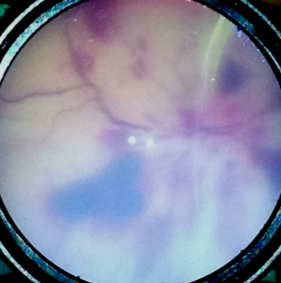
retinalhemorrhagesSmallDr. Lantz, a pathology professor at Wake Forest Baptist Health in North Carolina, is one of two speakers at the Queens conference scheduled to talk about retinal hemorrhages. The other is ophthalmology professor Brian J. Forbes at the University of Pennsylvania School of Medicine.

In 2004, Dr. Lantz published a case study and critical literature review in the BMJ that cautioned against relying on retinal findings when diagnosing abuse. He has since encouraged pathologists to gather more data by capturing retinal images in all child deaths, whether or not abuse is suspected.

Dr. Forbes is a co-author of a 2009 study that concluded:

Retinal hemorrhages are highly associated with abusive head trauma, particularly in children under age 6 months. Increasing retinal hemorrhage severity is correlated with increasing likelihood of abuse.(1)

The Queens speaker list also features law-school dean and professor Joëlle Moreno from the Florida International University College of Law, whose talk is titled “The Impact of Media Perspectives on Abusive Head Trauma Litigation.”  She also addressed that topic at the 2014 Denver conference sponsored by the National Center on Shaken Baby Syndrome, where she said:

[T]he public’s understanding of the science and law of abusive head trauma is coming principally from media coverage… of criminal trials… The problem is the trial and the appellate courts are confusing valid medical evidence with outlier opinions promulgated by a handful of interested defense witnesses who don’t treat children.

For more of Prof. Moreno’s thoughts on the controversy, see her 2013 law review article “Dissent Into Confusion: The Supreme Court, Denialism, and the False ‘Scientific’ Controversy Over Shaken Baby Syndrome,” co-authored with attorney Brian Holmgren.

12thHeadingOther Queens presenters include Dr. John M. Leventhal, who is on the faculty at the Yale University School of Medicine and on the advisory board of the National Center on Shaken Baby Syndrome, and Dr. Christopher Greeley, professor of pediatrics at the University of Texas Health Sciences Center at Houston. In a 2012 commentary in the journal Pediatrics, Dr. Greeley praised the meta-analyses that had recently been published by Piteau(2) and Maguire(3), in which the researchers pooled the findings of many individual child-abuse studies in an attempt to achieve statistically meaningful numbers. Greeley wrote at the time:

Both of these reports, using different search protocols and analyzing different data from the same body of literature, independently confirm the diagnostic precision of retinal hemorrhages, subdural hemorrhages, and rib fractures for abusive head trauma (AHT). By independently using different strategies on the same body of literature and demonstrating similar results, we see clear support for these clinical findings, which are often used in diagnosing AHT.(4)

(For a response from three physicians who question his conclusions, please see http://pediatrics.aappublications.org/content/130/2/347.full/reply#pediatrics_el_54511.)

In 2012, in a keynote address at the Twelfth International Conference on Shaken Baby Syndrome/Abusive Head Trauma, Dr. Greeley dismissed critics of shaken baby theory as child-abuse denialists who are manufacturing controversy where there is none.

I’m not sure how much common ground the various speakers are going to find at this fall’s conference, but I’m glad to see that the two sides are starting to appear on the same programs. For the conference agenda and registration form, follow this link.

(1) Binenbaum G, Mirza-George N, Christian CW, Forbes BJ. “Odds of abuse associated with retinal hemorrhages in children suspected of child abuse,” J AAPOS 2009 13(3):268–272. Available at http://www.ncbi.nlm.nih.gov/pmc/articles/PMC2712730/

(2) Piteau SJ, Ward MGK, Barrowman NJ, and Plint AC. “Clinical and radiographic characteristics associated with abusive and nonabusive head trauma: a systematic review,” Pediatrics 2012 130(2):315–323.  Available at http://pediatrics.aappublications.org/content/early/2012/07/03/peds.2011-1545.full.pdf

(3) Maguire SA, Kemp AM, Lumb, RC. “Estimating the probability of abusive head trauma: a pooled analysis,” Pediatrics 2011 128(3):e550–e564. Available at http://pediatrics.aappublications.org/content/128/3/e550.full

(4) Greeley CS. “The Evolution of the Child Maltreatment Literature,” Pediatrics 2012 130(2):347–348, available at http://pediatrics.aappublications.org/content/130/2/347.full#xref-ref-8-1

1 Comment

Filed under abusive head trauma, AHT, keith findley

Breathtaking Strength Under Heartless Interrogation

AllisonInterrogationCloser

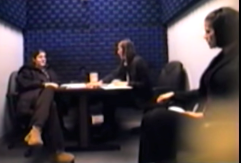
The interrogation of Christiane Allison

The support group for convicted father Clayton Allison in Alaska has posted a disturbing video that not only reveals the heartless tactics employed by police investigators but also showcases the extraordinary strength of Clayton’s wife Christiane, who seems to have been the only honest person in the room during her interrogation.

From the beginning, Christiane Allison says, she believed her husband’s report that he had accidentally left the baby gate open, allowing their 15-month-old daughter Jocelynn to fall down the stairs. Based on medical opinion, Clayton was convicted of second degree murder this past February, and sentenced last week to 30 years in prison.

The interrogation was conducted in January of 2009, four months after the incident, when the police called the child’s mother to the station to tell her that the medical examiner had declared Jocelynn’s death a homicide. In the video, two state troopers are trying to convince Christiane, 22 years old at the time, to call her husband immediately, on a secretly taped line, and ask him what really happened that day.

“Either you’re on the side of Jocelynn or you’re on the side of Clayton,” one officer explains, insisting that Christiene look at the autopsy photos and mocking her statements that she loves her daughter.

Since Jocelynn's death, her mother has been diagnosed with Ehlers-Danlos Syndrome.

Since Jocelynn’s death, her mother has been diagnosed with Ehlers-Danlos Syndrome.

Christiane steadfastly refuses to cooperate with a secret taping. “If I can tell him it’s being taped, I’ll make that call,” she says, but “I will not be deceitful.”

“Clayton has been lying to you every day since September,” the interrogator sneers. “The fact that Clayton makes love to you knowing he did this to your daughter, that’s deception,” and she thrusts in Christiane’s face a color glossy from the autopsy that shows the skin of the girl’s face peeled back and bunched up under her chin.

Early in the interrogation, Christiane had said, “Could you please not show me that one?” and, when the officer persisted, “Or at least don’t show her face all mutilated like that.” Four hours later, her protests are louder and more forceful. “Don’t accuse me of not loving my daughter because I won’t look at that picture,” she seethes, “I’m not looking at that picture because I don’t want to look at that picture every time I go to sleep… Regardless of what happened to her, I don’t want that picture in my head.”

While showing her frustration at the cruel and irrational interrogation, Christiane is not confused by the tactics. Accused of being too calm for a mother who has just learned her child was murdered, she explains she is showing her “cold face” because “words are too important” to let her emotions control the moment. “When I walk out of that door I’ll probably fall apart,” she predicts, “but right now I’m being a politician.” Reiterating that she will make no decisions as long as she’s in the interrogation room with them, she offers—sagely, I thought—”Life is too short for rash decisions.”

AllisonGroupChristiane even acknowledges that the troopers are only doing their jobs, looking for the truth, but she declines to cooperate with their deceptive strategy, and she refuses to accept on the spot that her husband murdered their daughter. “I’m taking every word you’re saying with a grain of salt,” she says. “I don’t believe anything until I’ve thought about it, I’ve prayed about it, and I’ve come to my decision.” Unaware that she is free to leave, Christiane interrupts the histrionics at one point,  “I don’t know how else to do this with you,” she says, clearly exasperated. “We could go around and around forever.” The interrogator stays in character, though, responding that she is personally disturbed by Christiane’s “reluctance to have an open mind about what happened.”

The video ends with Christiane alone on the moral high ground, when her parents arrive with news that her husband was arrested earlier, and she realizes her interrogators had kept pressuring her to call him at home long after they knew he was no longer there. “You’ve been in my face this entire time that Clayton is deceiving me,” she simmers, “but it’s OK for you to do that, when I’ve been completely honest with you?”

The video is just short of 34 minutes long and well worth watching, available on the Free Clayton Allison web site and on YouTube. What I find chilling is the troopers’ willingness to treat a grieving mother with such callous contempt. Christiane Allison was not home the day of the incident. She was never a suspect. But the police were sure her husband had been lying to her—because that’s what the doctors told them—and because she believed her husband, the troopers were willing to accuse, berate, and taunt her for four hours, while she didn’t change her story by an inch. Do the doctors know how the police conduct these interrogations? Do they care?

Of course watching the video reminds me of Scenes of a Crime, the award-winning film that eventually led to the release of Adrian Thomas in New York.

AllisonSupporters2The outpouring of support for the Allison family echoes other movements that have been springing up in child head-injury cases—on behalf of Joshua and Brenda Burns in Michigan, for example, and Melissa Calusinski in Illinois. I’m discouraged because the convictions continue, but I’m encouraged because defense groups continue to seek relief for those in prison—as in the cases of Albert Omenged Debelbot and Ashley Deone Debelbot in Georgia, Leo Ackley in Michigan, Jeffrey Havard in Mississippi, Brian Peixoto, and many others.

I hope the families and communities affected by these misguided accusations will keep speaking up, and that they’ll start connecting with others in the same position. See the page Families Working for Change for contact information.

If you are not familiar with the debate surrounding shaken baby theory, please see the home page of this site.

Copyright 2015, Sue Luttner

6 Comments

Filed under abusive head trauma, AHT, parents accused, SBS, shaken baby syndrome

Does the Brain Injury Prove Abuse, or Not?

Demonstration at the sentencing in the spring

Demonstration at the sentencing

The two shaking convictions in the news this season, ironically, are both based on brain findings alone, with no bruising, bone injuries, or other signs of assault—at least five years after the experts started saying that they never diagnose shaken baby based on the triad alone. In the widely reported case of Joshua Burns in Michigan, in fact, the diagnosis was based on only two of the three markers, retinal hemorrhages and subdural  hematoma.

BurnsProtestJune

Demonstration at CS Mott Children’s Hospital

A commercial airline pilot active in his local church and community, Joshua Burns was convicted of child abuse in December of 2014. Supporters immediately launched a web site and media campaign protesting his innocence, and now the Michigan Innocence Clinic is appealing his conviction.  Naomi Burns, now 18 months old, seems to have recovered fully. Her mother Brenda Burns has regained custody, but Joshua has been denied any contact with his daughter since April of 2014.

Michelle Heale sentencing reorted on Asbury Park Press

Michelle Heale sentencing, Asbury Park Press

In New Jersey, meanwhile, child care provider Michelle Heale has been sentenced to 15 years in prison, with the requirement that she serve at least 85% of her sentence. She was convicted of aggravated manslaughter and child endangerment in April.

Michelle said 14-month-old Mason Hess choked while eating a tube of applesauce, but doctors concluded from the brain findings that he had been shaken to death. The only visible evidence of trauma was a bruise on his forehead, suffered several days earlier in a fall in his home. He had been sick with coughing and copious mucous, and had just started taking medication the day before.

The coverage of the sentencing last week brings home how an abuse diagnosis amplifies the pain for everyone. The child’s mother asked the judge to impose the maximum sentence for “the monster who stole our son’s life,” and her husband addressed Michelle directly:

We truly believe that you should die for what you did to Mason, just not yet. But when you do, your true sentence will begin. We know that the devil himself has saved a special place in hell for you because only the most evil being would hurt an innocent child, an innocent child who cannot protect himself.

Judge Francis J. Vernoia imposed only half the maximum sentence of 30 years, but he chastised Heale for refusing to “take responsibility” for Mason’s death. Kathleen Hopkins at the Asbury Park Press wrote:

Vernoia noted, however, that Heale is at risk of committing another offense because she has refused to take responsibility for her actions. The judge said that despite overwhelming evidence of her guilt, Heale told a doctor during a mental examination that her conscience is clear.

The judge saw overwhelming evidence of her guilt, but I don’t.

The prosecuting attorney told the court that the child suffered “severe brain, spine and retinal damage,” but the injury to the spine was microscopic blood identified at autopsy, a finding consistent with the time the boy spent on a respirator. In fact, the prosecution was based on subdural hematoma, retinal hemorrhage, and brain swelling.

The historical context:  In 1998, after Judge Hiller Zobel released convicted British au pair Louise Woodward with a sentence of time served, several dozen child abuse experts signed a letter to the journal Pediatrics protesting media coverage sympathetic to the defense. The letter made this statement about the diagnosis of infant shaking:

The shaken baby syndrome (with or without evidence of impact) is now a well-characterized clinical and pathological entity with diagnostic features in severe cases virtually unique to this type of injury—swelling of the brain (cerebral edema) secondary to severe brain injury, bleeding within the head (subdural  hemorrhage), and bleeding in the interior linings of the eyes (retinal hemorrhages). Let those who would challenge the specificity of these diagnostic features first do so in the peer-reviewed literature, before speculating on other causes in court.

Whether or not you accept that guideline—which I don’t—the prosecution of Michelle Heale is consistent with it.

In about 2010, however, after the Audrey Edmunds reversal, I started hearing a different message at child abuse conferences.

At the Eleventh International Conference on SBS/AHT, for example, Dr. Robert Block, then the incoming president of the American Academy of Pediatrics, rejected “the so-called triad,” with the comment:

Only people who are not active physicians working with children, naïve journalists, and professors with a biased agenda would propose that only three signs and symptoms support a diagnosis.

And in 2011, Dr. Carole Jenny presented at the New York Abusive Head Trauma/Shaken Baby Syndrome Training Conference, using a PowerPoint that featured this statement:

No trained pediatrician thinks that subdural hemorrhage, retinal hemorrhage and encephalopathy equals abuse. The “triad” is a myth!

But the conviction of Michelle Heale seems to be based on the presence of the triad, combined with faith that the effects of a serious shaking assault are always immediate. My best guess is that the diagnosis rested largely on the extensive bleeding in the child’s retinas, bleeding that the child abuse experts insist is caused only by abuse. During the trial, pediatric ophthalmologist Dr. Alex Levin was quoted in USA Today as saying, “This is a victim of abusive head trauma. I can’t think of another explanation.”

February 2022 Update:  Law Professor Colin Miller in New Jersey has filed an application with the state Conviction Review Unit, requesting that they “correct an injustice and set Michelle Heale free.”

Josh Burns with his daughter Naomi

Josh Burns with his daughter Naomi

Retinal hemorrhages were also behind the diagnosis in the Joshua Burns case, where the eye exam did not take place until 11 days after the presumed shaking. The Torn Family web site, about the Burns case, offers both prosecution and defense expert opinions, making it possible to unravel some of Naomi’s complex medical history.

Her delivery was prolonged and difficult. Four times, the doctors attached the vacuum-extractor to Naomi’s head and pulled, and four times, the cap popped off. Finally, she was delivered by C-section.

She had difficulty latching onto the breast, and she was gaining weight slowly, so Brenda was pumping breast milk and feeding her daughter with a bottle, which was easier for Naomi to suck on. The girl’s  head circumference was growing at a faster rate than the rest of her body.

Bruising on newborn Naomi from the vacuum-extraction cap

Bruising and abrasions at birth from the vacuum-extraction cap

Then one Saturday afternoon when Naomi was about 11 weeks old, Joshua was at home alone with her, holding her on his lap. Brenda had gone to the hair salon, where the computer asked for a PIN number to go with the credit card. She called her husband, who gave her the number and then, he says, while putting the phone down, almost dropped Naomi, catching her by the head and face before she hit the coffee table.

The scratch on Naomi's left temple, after her near fall

The red mark on the left side of Naomi’s forehead, after her near fall

When Brenda got home, Joshua told her what had happened and showed her the red mark on Naomi’s face. Brenda says she thought it looked like a fingernail scratch, something she’d seen many times in her years as a nurse. (She had quit her job at a local hospital just a few months earlier, in preparation for Naomi’s birth.)

Their daughter seemed fine that night, Joshua and Brenda say, but over the next several days they took her again and again to the doctor and hospital for vomiting, pallor, and uneven breathing, only to be reassured and sent home. On the third day, when she had a seizure during an examination, she was admitted to the hospital. The first reading of the intake MRI identified only “benign enlargement of the subarachnoid spaces” (BESS), which means there was a little more room than usual between the brain and the skull, a not-uncommon condition of infancy that usually resolves on its own. It does, however, predispose to subdural hematoma.

Naomi and Brenda Burns

Naomi and Brenda Burns

Doctors attributed the infant’s seizures to an unidentified gastro-intestinal virus, and after a week in the hospital she was sent home, with anti-seizure medication. Her parents brought her back within hours, though, worried about more vomiting, fussiness, and pallor. At that point, while following up on a possible metabolic disorder, doctors performed a dilated eye exam and were surprised to find what the child abuse report identified as “bilateral multilayer retinal hemorrhages extending to the periphery,” the pattern considered by most child abuse experts to result exclusively from shaking.

“The retinal hemorrhages were an incidental finding,” Brenda says, “but they changed everything.”

Radiologists re-examined the initial MRI and reached a new conclusion:  They still determined that Naomi had BESS, but they also saw old subdural bleeding, possibly dating back to her traumatic birth, and a small amount of fresh subdural blood. Naomi was diagnosed as a shaken baby, and prosecutors targeted Joshua as the abuser.

The defense brought in pediatric ophthalmologist Dr. Khaled A. Tawansy, a retina specialist, who wrote in his report:

The retinal hemorrhages that were seen by the ophthalmologist at University of Michigan and documented by Ret-Cam imaging were predominantly superficial (sub internal limiting membrane or nerve fiber layer or intra-retinal)… [These types of hemorrhages] occur regularly with abrupt elevations of intra-cranial pressure (as in acute subdural hematoma) when the pressure in the cerebrospinal fluid surrounding the optic nerve exceeds the pressure of venous return in the retina as it drains into the optic nerve.

The child abuse doctor in the Burns case asked for advice from the same pediatric ophthalmologist who testified against Michelle Heale, Dr. Alex Levin in Philadelphia. In an email exchange posted on the Torn Family web site, the child abuse doctor summarizes Naomi’s medical history, acknowledging but discounting the traumatic birth. She reports the eye findings in detail and notes that the child has “persistent thrombophilia,” a clotting disorder.

Dr. Levin’s response:

Impressive documentation. Very well done.

Not sure what the question is. I can’t think of another diagnosis other than abuse assuming no obvious coagulopathy or other event.

Apparently Dr. Levin missed the mention of thrombophilia in the original note, because later in the thread, when the pediatrician asks him about it, he writes:

Do you mean thrombocytosis?
Either way we have no idea what this might do re retinal bleeding and could be considered to throw the retinal findings into question. We just don’t know

I don’t know what was said about all of this in court, but it seems to me that retinal hemorrhages are starting to play a very large part in these diagnoses. In this case, the retinal hemorrhages themselves are suspect, and the only other evidence of abuse is subdural hematoma in a child with BESS.

Now the state is trying to terminate Joshua’s parental rights. Those hearings wrapped up in June, and the family is waiting for the judge’s decision.

I don’t understand why the child abuse doctors are so sure Naomi was abused, and I’m even less clear on why the state has decided that her father and not her mother must be guilty. The accident Joshua reported—presumed to be a lie invented to cover up abuse—happened 11 days before doctors ever considered the possibility of head trauma.

I am sorry that another family has been caught up in this tragedy, but I am heartened by the enthusiastic support that Joshua and Brenda Burns are receiving from their community. And I have high hopes that the ongoing coverage will bring more light to the debate about the reliability of a shaken baby diagnosis.

September 2015 update: The court has adopted a treatment plan that allows for reunification of the Burns familly, which is good news if you ignore the irony that the only thing between  the Burns family and reunification is the court.

copyright 2015, Sue Luttner

If you are not familiar with the debate surrounding shaken baby syndrome, please see the home page of this blog.

7 Comments

Filed under abusive head trauma, AHT, parents accused, SBS, shaken baby syndrome

“Medical Child Abuse”—Be Careful What You Post

bubby&familypngWhat started out as a feel-good story about the kindness of strangers has turned into a CPS nightmare for a family in the Pacific northwest, where doctors at Seattle Children’s Hospital have accused Thomas Everson and his wife Brandi McNerny Everson of exaggerating their son’s disabilities and subjecting him to unnecessary medical care. The diagnosis has several names, including “medical child abuse” and “caretaker-inflicted illness.”

The tale started in February, when the family issued an on-line request asking people to send their special-needs son “Bubby” a card for his ninth birthday, maybe with some stickers inside, because Bubby loves opening mail, especially when he finds stickers inside. Bubby lives with both physical and mental impairments, the long-term effects of a virus he contracted in utero, which makes it congenital Cytomegalovirus or CMV.

Cartoonists joined the fun

Cartoonists joined the fun

The family’s request for mail went viral and Bubby received thousands of birthday cards, a development that led to even more coverage, like this follow-up piece from the Fox news station that ran the first story. Overwhelmed with good wishes, the family started passing along the bounty to other special needs children. “It has changed his life,” Bubby’s mother Brandi said on camera, “He’s so happy.”

A few months later, though, when Brandi rescheduled one of her son’s many doctor appointments, CPS workers followed up with a home visit to investigate the “missed” appointment. Brandi later told television reporters that the social workers “seemed very concerned about the stacks of mail piled inside their home.”

Two weeks later, CPS workers arrived to take Bubby into foster care, allowing his stunned mother only a few minutes to pack him a bag and say good-bye. The couple is now frantic about  their son’s welfare, they say, as his medical and psychological needs are complex.

The Eversons told news reporters that they fear the stacks of mail gave social workers the wrong impression, but I have a different theory. I wonder if it was the family’s on-line advocacy for their son that brought them to the attention of the child abuse team.

bubbyBeachThis explanation occurred to me because last year I read an article by Dr. Ana N. Brown at Seattle Children’s Hospital and several of her child protection colleagues, “Care taker blogs in caregiver-fabricated illness in a child: A window into the caregiver’s thinking?,” in the journal Child Abuse and Neglect (38[2014]488–497). The paper reported on three children (a “non-consecutive convenience sample”) seen at Seattle Children’s Hospital with illnesses the doctors concluded were imagined or induced by their mothers. All three children improved when they were removed from their families—although two of the three seem to have chronic conditions that still require treatment. All three mothers had been posting on the internet about their child’s ill health, at least two of them with on-line fund-raising appeals. In their paper on the phenomenon, the authors wrote, “This online seeking of attention and secondary gain provided a new dimension to caregiver-fabricated illness in a child.”

bubbyMomIn December of 2014, before the Everson family knew their appeal for mail would catch fire in the media, Brandi had started a GoFundMe page to raise money for a “sensory room” for Bubby, a safe place with textured walls and specialized play areas where he could de-stress and develop his motor skills. The family had already raised more than the $5,000 they were aiming for, so they had shut down the site before the accusations arose—now they have halted renovations and reopened the site as “Attorney for CPS Case+Sensory Room.”

In a news interview days after her son was taken, Brandi said she was shocked when social workers whisked him away. “We were communicating with the CPS investigator and following all of her suggestions,” she said—a line that echoed when I reviewed the Brown et al. paper and came across this paragraph:

In two of the cases, the parents continued blogging about their children’s reported illnesses after court ordered intervention. This behavior was viewed as an indicator that the initial protective intervention had not been successful and the child remained at risk. This information became crucial for investigators, as the parents otherwise appeared compliant with court ordered evaluations and supervision plans and appeared to have responded to the protective interventions. Investigators reported that the parent’s continued on-line blogging content was considered strong evidence that the child remained unsafe to return home.

bubbyBrandi

Brandi McNerny on Facebook

In their journal article, Brown et al. described some of the features of the tell-tale postings, which included distortion of the medical facts, an emphasis on the caretaker’s challenges instead of the child’s, a negative characterization of doctors, and fund-raising activity. “Through one website,” the doctors noted, “we learned that the family used the donated money to buy expensive durable goods which would directly benefit the parents.”

The Everson family’s plans for a “sensory room” for Bubby would seem to put the boy’s interests first, but I’m pretty sure the doctors would not approve of fund-raising to fight the accusations, and I fear that the from-the-heart Facebook video that Brandi posted, after she realized what she was accused of, has already been deemed to place the emphasis on her pain instead of her child’s needs. I think this situation might be a legitimate circumstance for the adjective “Kafkaesque.” (Dec. 2015 update: The family has removed their presence from the web.)

Custody hearings for Bubby Everson concluded earlier this week, amid television coverage from Fox news and King 5 that give some insight into the specific charges. Bubby slept in a special bed with webbing around it, for example, which the state apparently characterized as an attempt to imprison him—his parents say the netting is to keep him safe, so he won’t fall on the floor during a seizure. The state also seems to have argued that Bubby does not have autism, as his parents have claimed, and that he does not need the orthotic boots, feeding tube, or wheel chair that are all part of his life. The parents provided medical records showing that their son has been treated for “autism spectrum disorder” and argued that the other interventions were all prescribed by medical professionals and paid for by state insurance.

The news reports I’ve seen of this case haven’t raised any questions about the overall reliability of a “medical child abuse” diagnosis. The hearing coverage from King 5, for example, featured an interview with an attorney and former CPS worker who said, “For a court to step in and get an order to remove a child, something very serious has happened… Quite honestly, most of the time it doesn’t rise to this level, where you get a team of doctors from Children’s stepping in. And so, that’s going to get the attention of the court. It certainly got the attention of the department.”

“Medical child abuse” and “caregiver-fabricated illness” are the new terms for what was once called “Munchausen syndrome by proxy,” a reference to the confabulations of the protagonist in a set of satirical tales from the 1700s inspired by a real-life baron who famously enjoyed recounting his exploits in the Russo-Turkish war. In Munchausen syndrome, a patient lies about his or her own symptoms. Munchausen by proxy, of course, means inventing an illness for someone else. Child abuse experts like Dr. Carole Jenny, who joined the Seattle Children’s Hospital staff in 2014, are encouraging the new terminology—the publicity for a 2008 book Dr. Jenny co-authored argues:

[T]he term Munchausen syndrome by proxy should be retired permanently and replaced with a commonsense appreciation that children can be abused by their parents in the medical environment. Physicians who find themselves providing unnecessary and harmful medical care can see the abuse for what it is, another way parents can harm children.

Dr. Jenny is also an outspoken proponent of shaken baby theory—she gave this talk in Tel Aviv in 2013 (only the introduction is in Hebrew; her presentation is in English).

I fear that we are now facing a wave of inaccurate “medical child abuse” diagnoses—consider, for example, Justina Pelletier, whose health continued to decline for 16 months before the courts rejected the advice of Boston Children’s Hospital and returned her to her parents last June. While Justina’s custody battle was still in the news, the web site Lifting the Veil, which focuses on reform of the child welfare system, posted this round-up of Munchausen by proxy diagnoses that turned out to be inaccurate.

Like shaken baby syndrome, the diagnosis of medical abuse rests on the subjective opinion of the child abuse experts, and it includes the assumption that the child’s caretakers are lying, a combination that makes me very nervous.

I’m not saying that medical child abuse doesn’t happen, only that it’s treacherous territory. Most disturbingly, the diagnosis, like shaken baby, is another opportunity for the families of children with rare or poorly understood medical conditions to be wrongfully accused of abuse.

June update: The judge ruled to keep Bubby Everson in foster care for now. His parents are preparing for a fact-finding hearing, and still maintaining their Bubby’s Journey and  Bring Bubby HOME Facebook pages.

December update: The family has taken down both their Facebook and GoFundMe pages.

 copyright 2015, Sue Luttner

If you are not familiar with the debate surrounding shaken baby syndrome, please see the home page of this site.
9 Comments

Filed under parents accused

Shaking Theorists Repel Criticism

PBSNewsHourSBSWhile ripples persist in the wake of last month’s news stories questioning shaken baby syndrome in the courtroom, innocent parents and babysitters are still going to prison and most press coverage still treats shaking theory as established fact. Now the news magazine of the American Academy of Pediatrics, AAP News, has published a  commentary that dismisses the controversy as a “false debate” and criticizes The Washington Post coverage in March as “unbalanced, sowing doubt on scientific issues that actually are well-established.”

The commentary’s authors, Drs. Howard Dubowitz and Errol R. Alden, argue that both the Post article and the PBS NewsHour segment that ran the same week make too much fuss over the views of only a few doctors:

What are the facts? Similar to the so-called debate over climate change, it involves a tiny cadre of physicians. These few physicians testify regularly for the defense in criminal trials — even when the medical evidence indicating abuse is overwhelming. They deny what science in this field has well-established. They are well beyond the bounds where professionals may disagree reasonably. Instead, they concoct different and changing theories, ones not based on medical evidence and scientific principles. All they need to do in the courtroom is to obfuscate the science and sow doubt.

globalWarmingI’m not sure which side is supposed to be which in the climate change reference. In the fall of 2014, at the conference of the National Center on Shaken Baby Syndrome, law professor Joëlle Anne Moreno closed her talk with a clip from comedian John Oliver that I think was intended to equate the critics of shaken baby theory with the 4% of scientists who still deny that human activities affect climate change. But I remember the era, a few decades ago, when a handful of researchers was raising the alarm about climate change while mainstream scientists and public opinion dismissed them as fringe thinkers, and I just reviewed my notes from a pointed talk by forensic pathologist William R. Oliver at a 2013 pediatric head-injury conference organized by the publishing arm of the National Association of Medical Examiners, in which Dr. Oliver criticized the tactics and intellectual rigor of both sides in the climate debate, while drawing parallels with the struggle over shaken baby.

The AAP commentary joins the statement from the National Center on Shaken Baby Syndrome criticizing The Washington Post and PBS NewsHour coverage, as well as a posting to the National Association of Counsel for Children (NACC) listserve from law professor Frank Vandervort, who called the Post coverage “slanted and misleading” and criticized the American Bar Association for publishing a piece on its web site about shaken baby by Innocence Network attorney Katherine Judson. Attorneys Diane Redleaf and Melissa Staas at the Family Defense Center in Chicago have now published, on the NACC blog, their rebuttal to that posting.

A “Classic” Case

Debates aside, shaken baby theory is still winning in court. In mid-April, after a trial covered in the national press, a New Jersey jury found child care provider Michelle Heale innocent of murder but guilty of first-degree manslaughter in the presumed shaking death of a 14-month-old boy she was watching. Heale told emergency responders that the boy had seemed to choke on some applesauce. The Asbury Park Press web page offers complementary text and video treatments, including this moving anecdote from reporter Kathleen Hopkins:

Before Heale was led out of the courtroom in handcuffs, she turned to her husband, Michael, and asked him to take care of their children, a set of 5-year-old twins.

“Don’t let them forget me,” she said to him, sobbing.

According to coverage during the trial, pediatric ophthalmologist Alex Levin told the jury that the retinal hemorrhages found in the toddler’s eyes were a “classic” example of shaking injury—he said, in fact, that the image he was showing in court was scheduled to appear on the cover of a professional ophthalmology journal.

Dr. John Plunkett

Dr. John Plunkett

Another day’s coverage, however, quoted pathologist John Plunkett, who testified that “shaking had nothing to do” with the boy’s collapse. He rejected the specificity of retinal hemorrhages and said that choking was a possible trigger for the child’s brain swelling and ultimate death.

Like so many other children diagnosed as shaken, the boy had been sick in the days before his crisis, in his case with coughing and congestion, to the point of “vomiting mucous.” He was diagnosed with an ear infection and started on amoxicillin the day before his collapse. His only visible injury was an old bruise on the right side of his forehead, suffered in a fall the week before in his own home.

Other Disturbing Cases

rosenwinkel2

Cindy Rosenwinkel with her son

In Illinois, wife and mother Cindy Rosenwinkel was sentenced in April to six years in prison for the presumed shaking and slamming of an infant she was watching in 2011. According to press coverage, the judge imposed the minimum possible sentence. Ms. Rosenwinkel reported that she had slipped on the steps and fallen onto the conrete floor of the garage while carrying the infant in his car seat. The boy survived and is now described as “an active four-year-old.” Her supporters have created this web site protesting her innocence.

In a slightly encouraging update from Boston, the trial of Irish nanny Aisling Brady McCarthy has been postponed again, this time for a review of the case by the county medical examiner. Last week’s report was that a judge had denied a defense motion to drop the charges, so a delay for a review of the evidence is progress.

May 5 update: After two-and-a-half years in jail, Aisling Brady McCarthy has been released on $15,000 bail.  http://www.bostonglobe.com/metro/2015/05/05/bail-hearing-murder-case-for-nanny/g6z1mGNt6XeJuCpHw91IgL/story.html

burnsPhilIn the media, meanwhile, Dr. Phil ran a segment this week, “Was It Abuse, or Was It an Accident?,” sympathetic to Joshua and Brenda Burns in Michigan, where supporters have rallied behind the family even after Joshua’s child abuse conviction this winter. The page about the program on Dr. Phil’s web site offers a video clip in which Dr. Phil himself runs through the commonalities between the signs of shaken baby syndrome and the side effects of vacuum extraction—during the delivery of the Burns’s daughter, doctors had applied the vacuum device four times without success before eventually performing a C-section.

Joshua reported that when the girl was 11 weeks old, he had nearly dropped her while setting down his cell phone—he said he caught her by the face and head in one hand. She seemed fine that afternoon, but over the next several days, the couple took their daughter to the emergency room twice and to the walk-in clinic once because she was vomiting and appeared ill—on one visit they described her as “pale, cold, and clammy,” for example. Each time she was examined and released. Finally, when the girl developed breathing problems and the parents called 911, doctors looked more closely and found retinal hemorrhages and subdural hematomas, but no encephalopathy.

Dr. Phil’s show featured Dr. Robert Block, former president of the American Academy of Pediatrics, who had not reviewed the Burns case but said that critics of shaken baby “are absolutely wrong.” The program included no doctors who doubt the theory, but Dr. Phil was clear in his support of both Brenda and Joshua Burns. While Joshua serves his sentence, supporters maintain a web site at http://tornfamily.com/. The little girl seems to have recovered fully.

Fox news reported a different story this month, about doctors in Atlanta, Georgia, who accepted a father’s report that his 10-month-old son had fallen backwards while pulling himself up on a chair the day before his collapse. Surgeons removed a blot clot from his brain, and the boy has apparently recovered with no long-term effects and no child abuse accusations against the family. It’s hard to know from the news report what made the difference.

Meanwhile, the publicity for Child Abuse Prevention Month, April, has inspired news stories referencing children diagnosed as shaken in the past, such as this piece about a fund-raising race in South Dakota, this touching moment with a mother whose infant son was presumed shaken to death by his babysitter, and this feature about a loving family who adopted a child believed to be shaken by his maternal grandfather. With no details, it’s hard to know how accurate these stories are. I do believe that shaking a baby is dangerous and unacceptable, but I’ve seen so many dubious convictions that I find myself skeptical, of either the diagnosis or the correct identification of the perpetrator.

I feel like I’m back where I started in 1997, when a child care provider I knew was convicted of child abuse because a baby collapsed in her care, even though the child had been dropped off that morning with “a touch of the flu” and brain imaging showed old bleeding as well as new. In the Burns case, the prosecutors seemed to be arguing that Joshua abused his daughter the day he was alone with her and reported the near fall, but the breathing problems didn’t emerge until three days later. In a letter reproduced on the home page of my blog, a pathologist reported the case of a toddler hospitalized with vomiting for some 18 hours before the symptoms of an ultimately fatal head injury emerged. So why are the experts still saying that the symptoms are always immediate? In his appearance on Dr. Phil’s show, Dr. Block made the point, “In almost every one of these cases, the baby changes from being well to being in trouble when alone with a caregiver,” the same guideline that informed my 1997 case and that seems to be behind the accusations against another child care provider now on trial in Michigan. According to the press report of that case, the babysitter says the infant seemed to have a seizure, and she denies hurting the child in any way. Based on the brain injury, though, she is accused of “inflicting abusive head trauma, possibly by shaking the child.”

When is someone from the justice system going to stop and notice that the symptoms can evolve slowly over time? Or that there are other causes than abuse for subdural hematoma, retinal hemorrhages, and encephalopathy?

copyright 2015, Sue Luttner

If you are not familiar with the debate surrounding shaken baby syndrome, please see the home page of this blog site.

2 Comments

Filed under abusive head trauma, AHT, American Academy of Pediatrics, parents accused, SBS, shaken baby syndrome

The Word Is Out

WashPostTitleAfter 30 years of occasional, isolated coverage, both the national and the local media are starting to take a serious look at the debate about shaken baby theory—even as the accusations and convictions continue.

This past weekend Debbie Cenziper at The Washington Post published what I think qualifies as an exposé of shaking theory, the result of a full year of research that brought together the work of other Post staffers as well as students and teachers at half a dozen universities, including the Medill Justice Project at Northwestern University.

Dr. A. Norman Guthkelch

Dr. A. Norman Guthkelch

Shaken Science: A Disputed Diagnosis Imprisons Parents” offers a thorough but engaging analysis of the issues, including  helpful diagrams and the most accessible press treatment I’ve seen yet of the biomechanics. Cenziper opens, of course, with the story of one accused caregiver and interweaves more cases along the way, so that the piece is not only informative but also readable. She also reports the thoughts of several physicians, including Dr. A. Norman Guthkelch, the first person to propose in print, in the British Medical Journal in 1971, that shaking an infant could cause subdural bleeding.

The National Center on Shaken Baby Syndrome (NCSBS) has released a response to the Post piece, listing the professional organizations that have endorsed shaken baby theory and protesting:

 The Washington Post article portrays a “dispute” in the medical community as to the existence of SBS/AHT. There is a very small minority of proponents for the position that shaking cannot harm an infant, but this position is not supported by the science.

Like the letters protesting the film The Syndrome, the NCSBS response to the Post says that critics of shaking theory think that shaking a baby is not dangerous, although I don’t see anyone in the article making that statement. I think the question is whether the presence of the brain injury proves that a child was violently assaulted.

Cenziper’s article has been picked up in a number of regional newspapers, including the Hamilton Spectator in Ontario, the Daily Herald in Illinois, and the Dallas Morning News in TexaPBSNewsHours.

Then on Monday of this week, PBS NewsHour ran a segment on the shaking debate, a report titled “A disputed diagnosis that sends parents to prison for abuse.” The piece includes a look at the case of Drayton Witt in Arizona, whose appeal drew Dr. Guthkelch back into the arena, as well as interviews with child abuse pediatrician Dr. Lori Frasier—the author of a book on abusive head trauma written “for clinicians, investigators, prosecutors, and social workers”—and Katherine Judson from the Innocence Network.

Josh Burns with his daughter Naomi

Josh Burns with his daughter

Even before these national treatments emerged, regional news outlets had started giving sympathetic coverage to local cases. Last week in Michigan, Heather Catallo of ABC affiliate WXYZ  led off her video report about convicted father Joshua Burns with images of Burns’s supporters proclaiming their faith in his innocence at his sentencing hearing. The prosecutor argued for a harsh sentence, calling Burns a “danger” and objecting, “He’s not admitting that he did it. He’s still maintaining full innocence.” But the judge handed down the minimum sentence, a year in jail. Yesterday, WXYZ reported that prosecutors say they are not moving to terminate Joshua’s parental rights.

Also in early March, the Bennington Banner in Vermont ran a feature story by Keith Whitcomb Jr. about accused father Russell Van Vleck, found innocent by a jury in 2011 after a two-year nightmare for his entire family. Van Vleck’s son Colin, 5 weeks old the evening he quit breathing while lying on the couch next to his father, had been born with a skull malformation that had complicated his delivery.

TheSyndromeAnd the film exposé The Syndrome, which premiered in the fall of 2014, is being accepted at film festivals across the country (coming up: the (In)justice for All Film Festival in Chicago, April 13, and the Arizona International Film Festival in Tucson, April 18), staying in the news and triggering more coverage of the topic.

Outside of the mainstream press, web sites targeted to attorneys are also addressing shaken baby syndrome. On Wednesday of this week, the American Bar Association published an article in its Children’s Rights Litigation section by Katherine Judson at the Innocence Network, titled “What Child Welfare Attorneys Need to Know About Shaken Baby Litigation.” In February, the site LLRX.com, which describes itself as a web journal offering resources for legal professionals, published a valuable review of the debate, “Shaken Baby Syndrome: A Differential Diagnosis of Justice,” featuring live links to court decisions, journal articles, and other resources, by attorney, librarian, and writer Ken Struton, and the National Association of Public Defenders published an essay by public defender Jill Paperno, “Another Step Away From Bad Science – a Review of the  History and Science of Shaken Baby Syndrome in People v. Rene Bailey (December 16, 2014, Monroe County, NY).”

Still, the community of child abuse experts and the justice system remain committed to shaken baby theory. Yesterday in South Carolina, an 18-year police veteran was in court, accused of shaking his 3-month-old son into permanent brain damage. According to the local news report, the prosecutor told the judge that the boy’s injuries “could only have been caused by a violent shaking or by a fall of 20 feet or more.”

oklahomaChildrensIn Oklahoma last week, a step-father was charged with abuse after reporting that the baby fell from a bed. According to the News 9 coverage:

Detectives said they knew [the stepfather] was not being honest about what happened after doctors said the baby’s injuries weren’t consistent with his story. “The baby had to be violently shaken for him to have these injuries,” [Det. David] Thompkins said.

And this week in New York, detectives revisiting an old case charged a mother’s ex-boyfriend with manslaughter for the 2010 death of a 13-month-old boy who suffered injuries “consistent with shaken baby syndrome.” According to the report in The Buffalo News, detectives had acquired a more definitive medical opinion and carried out an additional interview with the suspect:

“In questioning Gonzalez, detectives were able to confirm a few things, though he didn’t confess, but it helped our case,” [Homicide Capt. Joseph] Gramaglia said. “We also obtained a medical opinion that bolstered the case.”

I don’t know what it will take to stop the ongoing tragedy of shaken baby theory in the courtroom. I have taken one small step, though. I’ve signed the Protecting Innocent Families petition, which asks for an objective, scientific review of the evidence behind today’s guidelines for diagnosing child abuse.

If you are not familiar with the debate about shaken baby syndrome, please see the home page of this blog.

copyright 2015, Sue Luttner

8 Comments

Filed under abusive head trauma, National Center on Shaken Baby Syndrome, SBS, shaken baby syndrome

Protecting Innocent Families: A Petition

zabethwCaption

February 2023 update: Protecting Innocent Families has been absorbed by the Family Justice Resource Center.

A coalition of accused families and the professionals who defend them is asking for an objective scientific evaluation of today’s medical guidelines for diagnosing child abuse, specifically but not exclusively shaken baby syndrome.

“Our child-protection system is in crisis, right now,” says Jennie Aspelin, whose husband Kristian stood accused for two years of shaking their baby to death. “If anything good can come out of our nightmare, it will be through our advocating for change.”

In November of 2010, Kristian Aspelin told emergency responders he had slipped in the kitchen while carrying 3-month-old Johan. But the child abuse expert at San Francisco General Hospital told police that children do not receive serious injuries from short falls and, further, that John’s brain injury proved he had been shaken to death.

The county charged Kristian with murder. For two years, while Kristian and his wife had lost their baby, and their 3-year-old needed stability, Kristian was forced to live apart from his family while fighting the charges. In time, experts hired by the defense found compounding factors in the medical records and conducted biomechanical tests that demonstrated the fall Kristian described could cause serious injury. The county dropped the charges, leaving the Aspelins deeply in debt but reunited.

So now Jennie Aspelin is helping to spread the word about the Protecting Innocent Families petition, a project that grew out of the 2013 conference for families falsely accused of child physical abuse sponsored by the Evidence Based Medicine and Social Investigation group.

The petition has just gone live, on March 4. Organizers say they hope to gather signatures from 1,000 people who believe they have seen dogmatic thinking about child abuse result in accusations against innocent parents and caretakers. Dr. Charles Hyman and film maker Susan Goldsmith

“We’ve been fighting these cases one at a time for 30 years,” says retired pediatrician Dr. Charles Hyman, a petition proponent who once headed the child protection team at Loma Linda University Children’s Hospital. “I’m happy to see somebody trying to address the root of the problem.”

Dr. Hyman explains that the early child-abuse physicians, in their sincere efforts to protect children from possible violence, established a number of guidelines that entered the courtroom without being tested scientifically. Sometimes, he says, a hasty diagnosis of abuse derails what should be a thorough search for a medical condition that might produce or predispose to the same findings. He has seen physicians diagnose abuse based the presence of multiple fractures, for example, without first testing the child’s vitamin D levels.

The diagnosis of shaken baby syndrome is a particular problem, the petition argues. Doctors have been taught for decades that a certain pattern of bleeding and swelling inside the infant skull proves the child was violently shaken. But now improved technology and accumulated experience have demonstrated that the same findings can also result from any of a long and growing list of legitimate medical conditions, so far including stroke, sickle cell disease, anemia, vitamin deficiencies, metabolic disorders, certain kinds of infection, and accidental injury. (For case examples, please see the Cases page on the Protecting Innocent Families web site).

The petition, which will be submitted to the U.S. Congress and to equivalent bodies in other countries, asks for an objective scientific review of the child abuse literature, to establish which opinions are based on statistically significant research and which opinions have become common knowledge without scientific review.

The petitioners suggest that the National Academies of Sciences take on the job, as a follow-up to their important and influential 2009 review of forensics in the courtroom. This petition comes from the affected families at the same time that forensics professionals are raising objections about other aspects of forensic science.

Even Dr. A. Norman Guthkelch, the pioneering pediatric neurosurgeon who first proposed infant shaking as a trigger for brain bleeding, has said he is horrified at the dogmatic thinking that now prevails. For an interview with Dr. Guthkelch by Joe Shapiro of National Public Radio, see “Rethinking Shaken Baby Syndrome.” For his academic statement on the subject, see “Problems of Infant Retino-Dural Hemorrhage With Minimal External Injury.”

Law professor Deborah Tuerkheimer at Northwestern University has published her criticism of shaken baby syndrome in a number of academic articles as well as an op ed piece in The New York Times,Anatomy  of a Misdiagnosis,” and recently a text book, Flawed Convictions:  “Shaken Baby Syndrome” and the Inertia of Injustice.

For the trailer to a provocative documentary about the debate over shaken baby syndrome, please see the web site for The Syndrome.

Both print and broadcast media have been raising questions about SBS diagnoses for years now, including the Wisconsin State Journal, The Washington Post, the ABA JournalThe New York Times Magazine, the Canadian Broadcasting Company, the LA Weekly, The Atlantic, The Atlanta Journal-Constitution, Seattle Met, FRONTLINEDiscover,  The Chicago Tribune, and the Los Angeles Times.

Feb. 2023:  The petition is now closed.

photos copyright 2015 Sue Luttner

If you are not familiar with the debate surrounding shaken baby syndrome, please see the home page of this web site.

8 Comments

Filed under parents accused, SBS, shaken baby syndrome