Category Archives: shaken baby syndrome

Current Cases All Over the Map

While I’ve been too busy to write about it the past few weeks, a number of intriguing, touching, and possibly important cases of alleged baby-shaking have been passing through the headlines.

Buried among the stories of accused parents, boyfriends, and babysitters, for example, was an Ohio judge’s decision late last month to drop charges against a teenage father, with the comment, “I think this case is full of doubt, frankly.” The move seems to have been popular in the community, as reflected in both the article and reader comments in the Newark Advocate.

More disturbingly  in Florida, the trial of a well-known child-care provider is now wrapping up, after unexpected testimony from  Dr. John Thogmartin, medical examiner for Pinelles and Pasco Counties. Thogmartin was interviewed in last summer’s Frontline episode about faulty science in infant death prosecutions. In the video, Thogmartin said he was skeptical of shaken baby syndrome, as he’d never really seen a case of it.  Consistent with that position, he’s reported to have testified in this case that the child died of blunt head trauma, not shaking… but apparently he does accept immediate symptoms, because he is testifying for the prosecution. Thogmartin was called back to the stand to address the defense theory that the child had been injured before arriving at the care-provider’s house, but it’s not clear to me from the Tampa Bay Times coverage either what he said or what he meant.

Just in the past few days, a young father in Arkansas has been arrested in what the news account called “a classic case of shaken baby syndrome.”  The diagnosing physicians seem not to have been swayed by the infant’s’s fragile health:  According to the Press-Argus coverage, 3-month-old Jayden Wright, who quit breathing in the care of his father on January 10, had weighed three pounds at birth on October 15, weeks short of his December 2 due date.

The same day’s news search brought up the sentencing of an Oklahoma father, who looks totally miserable in the photo that accompanies the story in the Oklahoman. He received a sentence of life in prison, making him eligible for parole in a little more than 38 years. His defense attorney had argued, unsuccessfully, that the man’s 5-month-old daughter had been injured in a fall a few days earlier, and had not been shaken by her father.

Meanwhile, in Raleigh, North Carolina, another father has been arrested in the presumed shaking death of his 5-month-old son. It’s not clear from the press reports why only the father is being targeted, since the couple seemed to be together when the breathing problems were discovered, first thing in the morning.

And there are dozens more. My heart breaks, for the children and for their families.

copyright 2012, Sue Luttner

If you are unfamiliar with the debate surrounding shaken baby syndrome in the courtroom, please see the home page of this blog.

2 Comments

Filed under abusive head trauma, SBS, shaken baby syndrome

Ernie Lopez Conviction Overturned

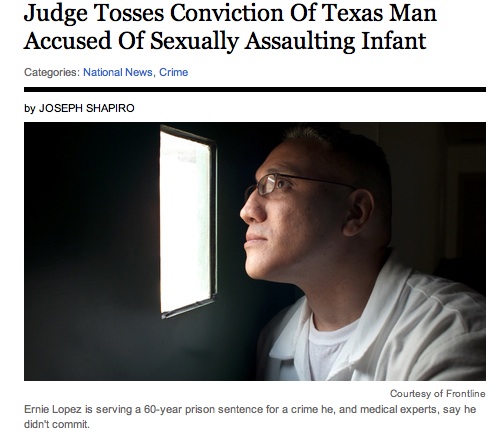
After years of pro bono work by attorneys convinced of his innocence, Ernie Lopez has won a court victory:  His 2003 conviction for the sexual assault of a 6-month-old girl has been overturned by the Texas Court of Criminal Appeals. The case also included allegations of infant shaking.

The court denied Lopez’s argument of actual innocence, but did agree that he’d had ineffective assistance of counsel, because his attorney had not offered medical witnesses to rebut the allegations at trial.

He is now being returned from state prison to the county jail, closer to his family, while prosecutors decide whether to retry him on the original charges and whether to move forward with a murder charge in the same case. The NPR web posting explains more about the highly unusual sequence. He has served nine years of a 60-year sentence for the assault conviction.

Last summer’s combined investigation into child death cases by NPR, Frontline, and Pro Publica resulted in articles about this case, at NPR story page,  The Child Cases and  Pro Publica story.

1 Comment

Filed under abusive head trauma, Ernie Lopez conviction, shaken baby syndrome

Can We Help Win a Pardon for Shirley Ree Smith?

christmas cactus blossom

April 6 update:  Governor Jerry Brown has commuted Shirley Smith’s sentence.  Shirley thanks everyone who wrote on her behalf, and I add congratulations to that.

I was expecting to hear by now from California Governor Jerry Brown about a possible pardon for Shirley Ree Smith (case summary), but there’s been no word yet.

Over the weekend, Shirley’s daughter Tomeka Smith told me they’re hoping to hear soon, because in a few weeks her mother will be taken back into custody—-but there’s still time for individuals to contact the governor’s office encouraging the pardon, as detailed below.

The Smith case continues to pop up in the press.  On the bright side:

Distressingly, a bereaved grandmother in Fresno, California, has launched a campaign against the pardon, on the theory that Ms. Smith is guilty. You can read the press coverage here.

Meanwhile, the governor’s office makes it easy for individuals to voice their opinions on these questions.  One click takes you to the contact page, at http://gov.ca.gov/m_contact.php

To make sure your comment is received in time, use the electronic form, which first asks for four pieces of information:  Your first and last name, your email address, and the subject of your comment.  Open the drop-down subject menu and select the “Pardon” item.  The user interface is odd, because you then have to click the “Submit” button before you’re given a text box for comments, but if you soldier on, you can get there.

1 Comment

Filed under abusive head trauma, AHT, SBS, shaken baby syndrome

Pardon Possible in Smith Case

It’s too early to celebrate, but the Sacramento Bee reports that Governor Jerry Brown is expected to pardon Shirley Ree Smith, the grandmother whose conviction in a shaking case was recently reaffirmed by the Supreme Court:

http://www.sacbee.com/2011/12/29/4150363/calif-gov-brown-weighs-clemency.html

Leave a comment

Filed under abusive head trauma, AHT, SBS, shaken baby syndrome, Uncategorized

Playing Chess With a Handicap

DSC01360A Dispatch From the Front

As the recent Russ Van Vleck case illustrates, SBS defendants can find exoneration in court, at least sometimes.

San Diego attorney Toni Blake, a consultant on pediatric head-injury cases, says the numbers are hard to pin down. “If you consider ‘win’ no time in jail for the defendant,” she said in an interview last year, “we have a 15 to 17 percent win rate.” That’s fewer than one in five—among defendants with attorneys astute enough to contact Toni Blake.

Which most do not. I received an email some days ago from a professional who’d been trying to help David Tatara, convicted last month of second-degree murder in the death of his girlfriend’s toddler. Reflecting on the trial, State of Florida vs. David Tatara, my correspondent wrote:

Chess with a Handicap

Even though the evidence against him is circumstantial, and sufficient reasonable doubt has been raised . . .   Mr. Tatara may well spend the rest of his life in prison, found guilty of murder by a jury of his peers, for a crime he may not have committed.

The prosecution was led by a State Attorney with considerable legal experience and obvious expertise in child abuse. He was meticulously organized and was assisted by a highly competent co-counsel and a team of support staff. Over two and a half days, he brought through police officers; paramedics; a crime scene investigator; two engineers; a child protection officer; two local doctors, including the treating ER physician; a child abuse nurse; and the mother of the deceased infant. The last prosecution witness was Dr. Randall Alexander, Medical Director of the Statewide Child Protection Program and a charismatic expert on infant head injury—well chosen, I thought, as the closer.

Mr. Tatara, an electrician by trade, was represented by a defense team of one: a small-town attorney with seemingly little trial experience and even less preparation. The attorney had found two expert witnesses, both restrained by budget. The defense was able to start and finish its case one morning before lunch.

Whichever way you measure it—time before the court or number of witnesses, don’t even consider hours of preparation—the prosecution outweighed the defense by a ratio of five to one. It would be like trying to play a game of chess against a highly experienced and accomplished chess master, when you’re equipped with one fifth the pieces and a handicapped king. It was not surprising that this jury, like so many, found in favor of the prosecution, which had left a far deeper impression.

Mr. Tatara is a hard-working blue-collar employee who, as best he could, was providing for his girlfriend and her two children from a previous marriage. The one thing that the defendant is clearly guilty of is believing that he could afford an adequate defense on an electrician’s paycheck.

Note that this case included a skull fracture and was diagnosed AHT, not SBS. Mr. Tatara called 911 after what he said was an accident involving a playpen and a tile floor. For the article that ran after his conviction, see Boyfriend Guilty.

1 Comment

Filed under abusive head trauma, AHT, shaken baby syndrome

Surviving Justice

IMG_4464Among the stream of new accusations and disappointing appeals comes an encouraging piece of news:  A Vermont jury has found 29-year-old Russ Van Vleck innocent of manslaughter in the 2009 death of his 5-week-old son Colin.

The press reports are already archived, so I’ll have to summarize here from the Bennington Banner and Manchester Journal coverage:

Van Vleck called 911 at about 10 pm on October 2, 2009, for help with his son Colin, who he said had stopped breathing while lying next to him on the couch. Van Vleck attempted CPR while waiting for the ambulance, following the instructions of the operator. He later told police the technique was different from what he’d learned in the National Guard. “I felt like I ate up 10 minutes of his life by not being able to do the CPR right for him,” Van Vleck said in a taped interview played at his trial, “I just wanted to get him to somebody who knew what they were doing.”

Colin had no bruises, fractures, or other signs of battering, and he’d been sick in the days before the incident—the doctor had diagnosed flu. Colin’s birth five weeks earlier had been complicated by a prematurely fused skull suture, a congenital defect that gave his head an odd shape. Still, State Medical Examiner Steven Shapiro, who performed the autopsy,  and his colleague at the ME’s office, neuropathologist Elizabeth Bundock, testified that the boy’s death could only have been caused by abusive shaking shortly before he stopped breathing. In opening remarks at the trial, Deputy State’s Attorney Christina Rainville was quoted:

“The evidence is going to show that Russ caused Colin’s death in a moment’s rage, a moment’s loss of control, and that Colin died of massive internal injuries consistent with being violently shaken, or being thrown into a soft object like a couch, a crib mattress, a bassinet, or a padded chair.”

Van Vleck enjoyed the support of friends and family throughout the 2-year ordeal. Attorneys William D. Wright and Joyce Brenner brought in neurosurgeon Ron Uscinski—a veteran of the Louise Woodward trial—and two Florida pathologists, who argued that the combination of birth trauma and skull defect had spawned the deadly bleeding and swelling.

The jury found Van Vleck innocent, but supporters report that social services has now targeted him as an abuse threat: He is allowed only supervised contact with his baby daughter, born in March of this year.

And of course he and his family are left with the cost of the defense and their new, notorious status in a community exposed to years of news coverage that assumed the father was guilty. Van Vleck’s National Guard deployment was delayed in 2009 because of his son’s death—I’ve seen no word yet on whether he will be heading out now.

The good news is that Van Vleck was able to fight the charges, with the support of his family and friends and help from a few doctors willing to weather the scorn that comes with testifying for the defense in a child abuse case. My next posting will tell a different, more common story.

March 2012.  More good news:  The State of Vermont has dropped family court proceedings against the Van Vleck family.

If you are not familiar with the debate surrounding the diagnosis of shaken baby syndrome, please see the home page of this site, at https://onsbs.com/

-Sue Luttner

12 Comments

Filed under abusive head trauma, shaken baby syndrome

Ripples Follow Smith Decision

Emily Bazelon, the author of last winter’s New York Times Magazine piece questioning SBS, has published a gratifying criticism of the recent, unfortunate Supreme Court decision in the Shirley Ree Smith case. Her new article is on slate.com, at:

A Vindictive Decision

As usual, the posted comments are especially interesting:  Most responders are focused on the legal issues, especially whether or not the Ninth Circuit Court of Appeals should be allowed to reverse a jury’s decision.

For those with personal experience in the arena, following Ms. Bazelon’s link to the November 2011 Posner decision is well worth the time.

A number of attorneys have also posted what read to me like critical analyses of the Smith decision, including:

Sherry F. Colb, The Supreme Court Preserves the Chain of Command by Returning a Grandmother to Prison

and

Vikram David Amar, The First Supreme Court Ruling of the Year.

I’m encouraged by the overall feeling I get of discomfort with the Smith decision.  Please do let me know if you have a different take on it.

-Sue Luttner

Leave a comment

Filed under abusive head trauma, shaken baby syndrome

Supreme Court Disappoints

For the Good News,
Start With the Dissent

The Supreme Court this week reinstated the 1997 conviction of grandmother Shirley Ree Smith, in the first shaken baby case I’m aware of to have reached the high court.

After following the Smith case for some years, I’m discouraged. The conviction has never made sense to me, logically, medically, or legally.

First, the argument for a motive was especially thin. Shirley Smith was not an isolated caretaker alone with a fussy infant: She was a grandmother on a trip from Illinois with her daughter and grandchildren, staying at her sister’s apartment in Van Nuys, California. Smith was sleeping in the living room with her grandson Etzel, 7 weeks old, and two other children. She claimed she found Etzel limp and unresponsive at 3:20 am, after she was awakened by another child’s nightmare. Panicked, she carried the baby to the next room, where her daughter dialed 911. Everyone in the apartment that night said that Etzel had gone to sleep peacefully on the couch the previous evening. No one remembers hearing him cry during the night.

At autopsy, though, doctors found fresh subdural and subarachnoid bleeding. The boy’s brain was not swollen, his retinas showed no hemorrhages, and everyone agreed the amount of blood was very small. Still, presenting a model of SBS I’ve never heard outside of this case, Dr. Eugene Carpenter and Dr. Stephanie Ehrlich from the Los Angeles County coroner’s office testified that the child’s instant death—caused by the tearing of his brainstem during the assault—had left no time for the other symptoms to develop. The brainstem was not autopsied for signs of shearing because, Dr. Ehrlich explained, “we wouldn’t have seen anything anyway.” Aging subdural blood was also present, but the doctors said that old subdural collections would not rebleed, so the old injury was not relevant.

Shirley Ree Smith was described by her family as a devoted mother and grandmother, always patient with children. Still, she was convicted on only one leg of the triad. One.

Smith was released from prison in 2006, after the Ninth Circuit Court of Appeals reversed her conviction, declaring the evidence against her “constitutionally insufficient.” A few days ago, the Supreme Court reversed that reversal, with the message that the Ninth Circuit had overstepped its bounds. “It is the responsibility of the jury—not the court—to decide what conclusions should be drawn from evidence admitted at trial,” the justices wrote.

Still, there’s some reason for hope, as the text of the decision includes an insightful minority opinion written by Justice Ruth Bader Ginsburg, who quoted papers by Ferris Bandak, Jan Leestma, Waney Squier, and others to support her observation,  “It is unlikely that the prosecution’s experts would today testify as adamantly as they did in 1997.” Before returning Smith to prison, Ginsburg wrote, “I would at least afford her a full opportunity to defend her release from a decade’s incarceration.”

A New York Times blog post presents the decision in its political context—as a slapping down of the Ninth Circuit Court, which is perceived as activist—at The Loyal Opposition.

The Christian Science Monitor has a balanced treatment, of course, at Supreme Court Rebukes Ninth Circuit.

To see the full written opinion, including the minority opinion at the end, go to The Decision.

I’m hoping there will be more to post on this case. If you see or hear coverage in your local media, please consider posting a comment or writing a letter to the editor.

Meanwhile, her attorneys have filed a clemency petition with Governor Jerry Brown.

April 6, 2012 update:  Governor Brown has commuted Shirley Smith’s sentence.  See the April 6 posting.

-Sue Luttner

12 Comments

Filed under abusive head trauma, shaken baby syndrome

Can Hospitals Be Held Accountable?

MarkFreeman

Attorney Mark Freeman

Like so many of us, attorney Mark Freeman in Pennsylvania was drawn into the shaken baby arena by chance. A close friend was accused of shaking his own child, and Freeman saw a quick and inaccurate diagnosis turn into a personal nightmare for an innocent family.

Freeman was not a litigating attorney.  He still specializes in elder law: estate planning, wills, long-term care provisions. After working on his friend’s defense, however, he’s not only become a courtroom resource for criminal attorneys faced with shaking cases, but he’s started fighting the battle on a new front. He’s filing civil rights suits against hospitals and their child protection teams, counties and their social service agencies, and individuals at these institutions on behalf of innocent families accused of infant abuse.

As those who follow this blog know, accused parents routinely miss out on their children’s infancies and can lose their jobs, their life’s savings, their freedom, and any semblance of a normal family life. Freeman’s suits ask the hospitals and counties to change their policies, or, in some cases, to enforce the policies ostensibly in place, to protect against hasty prosecutions and vindictive foster placement.

In two of Freeman’s civil-rights cases, prominent child-abuse specialists attributed multiple anterior rib fractures to abuse, but without ordering the blood tests that would have revealed vitamin D deficiencies—rickets—in both patients. One doctor at Penn State Hershey Medical Center testified inaccurately that the child’s fractures were posterior: Posterior rib fractures in an infant are believed by some experts to result almost exclusively from abuse, while anterior rib fractures are known to result from bone diseases, like rickets.

Even though exonerating medical evidence was available early on, the infants in both rickets cases spent months of their young lives in the care of strangers. Even with the accused fathers out of the house, the mothers were denied custody because they refused to believe that their husbands were guilty. One father spent a year in jail before being exonerated. Social services and police were depending entirely on the reports from the hospitals’ child protection teams.

Another commonality in the two rickets suits is a discriminatory policy at the Penn State Hershey Medical Center regarding expert testimony by faculty members. Hershey doctors testifying for the prosecution in child abuse cases are free to reference their faculty affiliations and conduct their correspondence on Penn State letterhead, and their activities are covered by the school’s liability insurance. At the same time, the school prohibits doctors testifying for child-abuse defendants from citing their faculty affiliations or corresponding on Penn State letterhead, and excludes their legal activities from coverage by the school’s liability insurance.

The most recent suit also questions the objectivity of both Hershey Medical Center and pediatric neurosurgeon Dr. Mark Dias, a leading proponent of shaking theory who has brought to his institution millions of dollars in federal grant money, to educate parents about the dangers of shaking.

For a news story about Freeman’s recent filing, see

http://www.courthousenews.com/2011/10/03/40229.htm

For the text of that suit, which includes an entertaining sequence for anyone who’s ever tried to get an answer from a prestigious specialist at a children’s hospital, go to

http://www.courthousenews.com/2011/10/03/rickets.pdf

2015 update:  Mark Freeman helped an accused family win compensation from the county that pressed their case.

copyright 2011, Sue Luttner

If you are unfamiliar with the debate surrounding shaken baby syndrome in the courtroom, please see the home page of this blog.

4 Comments

Filed under abusive head trauma, shaken baby syndrome

An Evolving Theory, a Tragic Tale

An editorial this week by a pathologist in Durango, Colorado, has alerted me to another way a life can be destroyed by a misdiagnosis of infant shaking.

Former Florida medical examiner Dr. Joan Wood died recently after a long and respected career that was marred toward the end by, among other things, two diagnoses of shaken baby syndrome that were later rejected.

Wood had resigned under a cloud in 2000, after harsh criticism from the district attorney when she’d derailed a high-profile adult head-injury case by changing her mind about cause of death. The SBS cases unravelled after she left office, when her successor took a second look at some of her other autopsies: Charges were dropped against one young father, and another was released after four years in prison on a manslaughter conviction. The previously vibrant, articulate pathologist is reported to have spent the rest of her life as a recluse.

Mourning the destruction of Wood’s career, former colleague Dr. Carol Huser wrote in the Durango Herald:

She was wrong at times, and when a medical examiner is wrong, people get hurt.

Dr. Wood got hurt, too. Badly. She lost her self-confidence, buckled under the fear she might be wrong and broke.

People think medical examiners should never make mistakes. They should foresee which evolving theory – such as shaken baby syndrome – will stand the tests of time and which will not. They should never be sufficiently moved by the death of an innocent to stretch an opinion or yield to bias or embrace the illusion that they know more than they do.

I think we can agree that Dr. Wood was yet another victim of the classic model of SBS. Our best hope from tragedies like this one is that more forensic pathologists will understand that SBS is “an evolving theory” and not an established fact.

Myself, I like to think that most medical examiners would agree that they “should never be sufficiently moved by the death of an innocent to stretch an opinion or yield to bias or embrace the illusion that they know more than they do.”

Read Dr. Wood’s Florida obituary.

See Dr. Huser’s full editorial in the Durango Herald.

A Texas Update

Congratulations to us:  The Comments page from last week’s controversial shaken baby piece in the San Antonio Express-News has enjoyed a major shift in tone over the past few days.

The three top vote-getters still reject any questioning of SBS, but the full Comments page now sports 13 posts, six of them critical of SBS theory.  Over the weekend when I posted The Distant Sound of Presses Turning, there were only eight comments, seven of them condemning the babysitter. Thank you to those of you who spoke up.  And good work:  The skeptics’ comments are thoughtful and well written.

Let’s hope the editors have noticed, and that the minority viewpoint is becoming more believable.

1 Comment

Filed under shaken baby syndrome