Tag Archives: SBS

Shaken: Tensions Build in Boston

bostonTeaPPhysicians and attorneys in Boston, Massachusetts, where the Louise Woodward trial brought shaken baby theory onto the national stage, are heading into another battle over infant shaking, as pediatricians clash with the medical examiner about the diagnosis and the state’s high court reconsiders past convictions.

Aisling Brady McCarthy, from the BBC coverage, http://www.bbc.com/news/world-europe-24569976

Aisling Brady McCarthy

Tensions started ramping up last summer, when the medical examiner’s office changed the cause of death in the case of 1-year-old Rehma Sabir, from “homicide” to “undetermined,” which convinced the district attorney to drop murder charges against the girl’s nanny, Irish national Aisling Brady McCarthy. Not quite a year earlier, with less publicity but for the same reason, the county had dropped charges against accused father Geoffrey Wilson. Then last December, the medical examiner’s office pulled back from a third homicide declaration in an infant death initially attributed to shaking, but the district attorney held firm and is still moving forward with charges against Pallavi Macharla, a child care provider who had been a physician in her native India.

Now the Massachusetts chapter of the American Academy of Pediatrics (AAP) has written a letter to Governor Charlie Baker calling for an investigation of the medical examiner’s office and warning that its staff might be listening to the opinions of defense experts, as quoted by Patricia Wen in The Boston Globe:

“Publicly available information questions whether individual examiners may have been influenced by participating attorneys and paid reports from defense medical experts,” according to the letter obtained by the Globe. “Sadly these extraordinary and alarming events call into question both the capacity and independence of our medical examiner’s office.”

tinyHandThis quote illustrates the kind of rhetorical thinking that can obscure logic when the topic is child abuse. Despite the implications of the phrase “paid reports from defense medical experts,” the state’s doctors are also paid for the time they spend preparing reports. The objection, then, must rest on who is paying, as if the opinions of the state’s doctors should necessarily prevail over the opinions of the defense experts. And I wonder whether the pediatricians have really thought through the question of “independence.” The medical examiner’s office is ordinarily on the same team as the detectives and the prosecutors, all agents of the state. In child abuse cases, the diagnosing pediatricians are also part of the prosecution team. In three instances in less than two years now, individual examiners have concluded that medical factors identified by defense doctors could have explained the infant deaths, putting the examiners at odds with physicians who are usually their allies. To me, that sounds like the essence of independent thinking.

The Massachusetts pediatricians seem to be asking the governor to step in and order the medical examiner’s office to follow the advice of the child abuse experts. Again from The Boston Globe coverage:

“The letter to the governor appears to represent growing frustration by the pediatricians’ organization, which had originally sought a behind-the-scenes solution to their concerns that fatalities from abusive head trauma — also known as ‘shaken baby syndrome’ — were potentially being wrongfully labeled as deaths caused by rare medical events….

“In early March, top members of the pediatricians’ group met privately with state public safety secretary Daniel Bennett and [Dr. Henry] Nields, the chief medical examiner, hoping they would agree to launch a comprehensive review of the handling of these child fatalities.

“Instead, Bennett later suggested to the pediatricians’ group that they ‘prepare a presentation’ for the pathologists at the medical examiner’s office. In response, in a letter dated April 29, the pediatricians’ group went directly to the governor demanding a review.”

In a follow-up debate on station WGBH in Boston, former Massachusetts attorney general Martha Coakley, who prosecuted British au pair Louise Woodward in 1997, insisted that the pediatricians were right in the first place, the medical examiner’s office “doesn’t have the training to make the right decision” in abuse cases, and individual medical examiners are “just not doing their jobs.” She dismissed critics of shaken baby theory as “15 to 20 people who have made a cottage industry out of attacking these diagnoses.”

Kieren wired up and ready to jump

The letter to the governor was signed by Dr. Michael McManus, president of the Massachusetts chapter of the AAP, and Dr. Stephen Boos, chairman of the chapter’s abuse and neglect panel and a proponent of shaken baby theory. In a break-out session at the 2012 conference of the National Center on Shaken Baby Syndrome, Dr. Boos criticized both the structure and the implementation of the 2011 Jumparoo study by biomechanic John Lloyd, PhD, which concluded that a child playing in a commercial jumping toy achieved the same magnitude of angular acceleration as adult volunteers shaking a biofidelic mannequin. “Shaking is no worse than a Jumparoo?” Boos jeered, “You’ve got to be kidding me.” In a review of Dr. Steven Gabaeff’s 2011 article challenging the pathophysiological connection between brain findings and a shaking diagnosis, Dr. Boos acknowledged Dr. Gabaeff’s scholarship but rejected his “teleological flights of fancy,” summarizing:

“I do not believe this paper develops a larger truth, though there are kernels of truth here and there. Instead, it displays the sorts of arguments we must refute when asserting the mainstream view of abusive head trauma.”

A month after the pediatricians’ complaint to the governor, the Massachusetts Supreme Judicial Court (SJC) recognized the reality of a debate about shaken baby theory, in its decision ordering a new trial for Oswelt Millien, a father who served five years in prison for the presumed 2009 shaking of his daughter. The court concluded that Millien’s attorney had provided ineffective assistance by failing to seek court funds to hire an expert witness for an indigent defendant, so that the opinions of the state’s experts went unchallenged at trial—that is, the same situation the pediatricians would like to see in the medical examiner’s office.

If the district attorney follows through with a trial of Pallavi Macharla, though, I expect both sides to bring experts to the courtroom. Macharla’s attorney JW Carney demonstrated in the debate with Martha Coakley that he’s already done his homework (probably when representing Geoffrey Wilson), but in case he hadn’t, he could look to the Millien opinion, which features in its footnotes a bibliography of key documents in the shaking debate. Millien’s previous appeal had been turned down by a judge who agreed he deserved a defense expert but concluded that a single expert would not have changed the outcome of the trial. In this decision, the judges conclude that the jury might have made a different decision if they had known the diagnosis is controversial:

By vacating the defendant’s convictions in this case and ordering a new trial, we do not claim to have resolved the ongoing medical controversy as to how often the triad of symptoms of abusive head trauma are caused by accidental short falls or other medical causes. We are simply recognizing that there is a vigorous debate on this subject, that arguments are being made on both sides with support in the scientific and medical literature, that this debate is evolving, and that, in the circumstances of this case, we do not have confidence in the justice of these convictions where defense counsel did not retain an expert to evaluate the medical evidence and, as a result, the jury heard only one side of this debate.

Because Oswelt Millien has already served his term, the state has little incentive to pursue a second trial, but the debate will be through the headlines again, both as the Macharla case unfolds and when the SJC reaches a decision on the pending appeal of Derick Epps, convicted in 2007 of assaulting his girl friend’s daughter.

July 2016 update: The SJC has ordered a new trial for Derick Epps, http://law.justia.com/cases/massachusetts/supreme-court/2016/sjc-11921.html

Meanwhile, the pediatricians are asking for an investigation of the medical examiner’s office. Myself, I am hoping for an investigation of the child abuse professionals who don’t understand the difference between “the mainstream view of abusive head trauma” and established scientific fact.

3 Comments

Filed under abusive head trauma, AHT

Appeals Court Recognizes Change in Medical Thinking

- from The Columbian

– from The Columbian coverage

A Washington state appeals court has granted a new trial to Heidi Fero, a mother and babysitter who was out of prison but still under court supervision on a child assault conviction when her appeal was heard. The decision, written for the 3-judge panel by Judge Linda CJ Lee, recognizes a change in medical thinking about both the timing of infant head injuries and the reliability of an abuse diagnosis in these cases. Specifically, the decision endorses this defense argument:

[N]ew material facts exist in the form of the now generally accepted medical paradigm that recognizes children can remain lucid for up to three days after suffering similar head injuries and those injuries are now known to be caused by much less extreme circumstances.

On a January evening in 2002, Fero was caring for pair of siblings, a 15-month-old girl and a 4-1/2-year-old boy, as well as her own two young children. At about 7:45 pm, she called the children’s father to report that the boy had been seen “pushing [his sister’s] head into the wall.” She says she comforted the little girl and, when she seemed to fall asleep, put her on a futon.

At 9:54 p.m., Fero called 911, after she noticed that the girl’s eyes were half-open and she could not be awakened. When the ambulance arrived at 9:59, the child was completely unconscious.

From the Free Heidi support page

A family photo from the Free Heidi support page

At the hospital, doctors found subdural hematoma, cerebral edema, and retinal hemorrhages. According to the case summary, six prosecution doctors testified at trial that the findings could result only from a major trauma like a car accident, a long fall, or abuse by an adult, and that the child would have become unconscious almost immediately after the assault. Several of the experts seem to have specified that the girl had been violently shaken.

Fero was initially sentenced to 15 years, 5 years above the statutory limit because of the “special circumstances” of the infant victim’s extreme vulnerability and Fero’s failure in her “duty to protect” a child in her care. A 2005 decision reduced her sentence to 10 years, with the objection that the judge had not submitted the special circumstances to the jury for adjudication before applying them.

The 2014 petition that reversed Fero’s conviction included affidavits from two physicians, pediatric neuroradiologist Patrick Barnes, who testified for the prosecution in the highly publicized 1997 trial of “Boston nanny” Louise Woodward, and forensic pathologist Janice Ophoven, who has testified that shaken baby syndrome is “controversial” and “an ongoing debate in the medical field.”

The Fero decision offers this quote from Dr. Barnes, “Over the past decade, many doctors—including myself—have changed their testimony and beliefs to bring them into accord with the scientific evidence and standards of evidence-based medicine.” And on the subject of timing:

Given the new medical research on lucid intervals, the testimony of the State’s experts to the effect that [the girl] would have immediately gone unconscious is unsupported by the medical literature. It is impossible to tell from the radiology or otherwise in the medical record when [the girl] was injured, and there is a significant chance that she was injured before she arrived at Ms. Fero’ s home.

In her statement, Dr. Ophoven cited the 2001 position papers by the American Academy of Pediatrics (AAP) and the National Association of Medical Examiners (NAME) to support her contention that the testimony at Fero’s trial in 2003 reflected the thinking of the medical community at the time. The AAP position paper has been superseded, however, by a 2009 statement that recommended clinicians avoid the term “shaken baby syndrome,” in favor of the more general “abusive head trauma,” and contained no specifics about diagnosing the condition or timing the injuries. The NAME paper expired without renewal and has not yet been replaced.

The decision quotes Ophoven’s summary:

[I]t is my opinion that much of the medical testimony presented during Ms. Fero’ s 2003 trial is no longer scientifically valid in light of recent advances in the medical community’ s understanding of the natural, accidental and non-accidental causes of cerebral edema, subdural hematoma and retinal hemorrhages.

Ophoven also concluded that the child had probably suffered her head injury about 12 hours before the first CT scan, that is, before she had been dropped off at Fero’s house.

In his statement opposing Fero’s petition, prosecuting attorney Anthony Golik did not address the question of whether medical opinion has indeed changed, focusing instead on the timing of the petition and the argument that new opinions by new experts should not constitute “newly discovered evidence” for the purposes of re-opening a case:

Every murder, serious assault, rape, etc, would be subject to vacation and retrial whenever a defendant found an expert to write an affidavit indicating there were new scientific theories which would explain the evidence in such a way as to possibly exonerate the defendant. This simply cannot be the standard this Court applies in Fero’s situation. A new medical opinion or a new medical theory is not a “material fact.”

Although the filing came more than a decade after her conviction, the judges concluded that Fero had exercised “reasonable diligence” regarding timeliness, considering that she was in prison when the medical debate was building and needed time after her release to find an attorney who could research the debate. The decision cited four other cases in the past few years where the convictions of child care providers were vacated—Audrey Edmunds in 2008, Kathy Henderson in 2012, Jennifer Del Prete in 2014, and Rene Bailey in 2014—based on the argument that a change in medical thinking over the past few years constituted “newly discovered evidence.”

This approach has been effective in righting past wrongs, but ironically, it will be less persuasive against recent convictions (like those of Cammie KellyMichelle Heale, and Joshua Burns, for example), since the debate has now been raging for a decade or more.

With the decision, the court released Fero from court supervision while she awaits the state’s response.

Like so many women in her position, Fero has received the support of her family and community through the years, and the decision in her favor noted:

Fero also submits several exhibits attesting to her positive influence on others while in prison. These are irrelevant to her petition to this court because they are not material to the conviction.

Press coverage quoted her attorney, J. Christopher Baird of Perkins Coie LLP in Seattle, who said, “Our client is a truly wonderful person, and it feels great to get the result we feel she deserves.”

If you are not familiar with the debate surrounding shaken baby syndrome, please see the home page of this blog.

copyright 2016, Sue Luttner

6 Comments

Filed under abusive head trauma, AHT, SBS, shaken baby syndrome

Innocent Family Petition Hits a Nerve

Geers twins

Geers twins

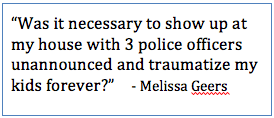
When child protective services separated Melissa and Anthony Geers from their five sons last spring, Melissa says, the pain was staggering. The worst part was watching the effects on their children: the 9-year-old’s full-blown panic attack, the 8-year-old’s holding his mom “so tight I couldn’t breathe,” the sudden interruption of breast-feeding for the 4-month-old twins (Melissa pumped throughout their foster placement).

The state filed to terminate the Geers’ parental rights just weeks after x-rays revealed rib fractures in both twins—but withdrew the suit 10 weeks later, after the Geers submitted opinions from eight outside experts who attributed the fractures to fragile bones, citing two underlying causes: First, the boys had a metabolic disorder that impedes bone formation. Second, like most twins, the youngest Geers had arrived early, 7 weeks early in their case. Because the rate of bone mineralization ramps up during the final trimester of gestation, premature infants in general are prone to weak bones.

photo by Doug Smith, Washtenaw Watchdogs

Anthony & Melissa Geers. Photo by Doug Smith, Washtenaw Watchdogs

But those explanations entered the record only because the Geers did their own research and called in their own experts. The state tore her sons’ lives apart, Melissa says, based on the opinion of one child abuse doctor “who never met me, my husband, or our kids.”

“We have two sons, now 10 and 8, who were traumatized by this experience,” she points out. “They don’t do the things they used to do. They are afraid. The child abuse experts need to understand what they are doing to children.”

Since their story hit the news, Melissa says, they have been contacted by an astonishing number of families with their own stories of ill-considered abuse diagnoses—most of them with far less happy outcomes. “How are the child abuse doctors not aware of all these other things?” Melissa asks. “That’s the part that bothers me the most. Why are they not doing their due diligence?”

GeersQuoteThe Geers say they understand how valuable it was to have a supportive community during their ordeal, as documented by Click on Detroit and later by Melissa herself in an essay on Medical Kidnap. Melissa says she and her husband now feel compelled to do what they can to shed light on a broken system. Earlier this fall, the Geers joined demonstrators at the University of Wisconsin Board of Regents meeting, where supporters of Joshua and Brenda Burns protested the Burns family’s treatment by the university’s Mott Children’s Hospital. As reported on this blog in the spring, the Burnses’ daughter Naomi was diagnosed as a shaken baby at Mott in 2014. While Naomi seems to have recovered fully, Joshua is serving a one-year sentence in the county jail. As he approaches his December release date, Joshua had been granted weekly visits with his family, through a glass window and a telephone handset, after a year and a half of no contact at all with Naomi—but those visits were cancelled after the first one. (For an insider’s view of the regents meeting, including video statements by Melissa Geers and Brenda Burns, please see the Washtenaw Watchdogs coverage.)

Accused father Andrew Sprint

Accused father Andrew Sprint

The Burns family and the Geers family found each other, and they also found the Protecting Innocent Families (PIF) petition, which calls for an objective, scientific review of the evidence base underlying today’s guidelines for diagnosing child abuse. The petition form includes an optional field where signers can identify the name of a defendant or family they are supporting. Of about 2,700 people who have signed the petition so far, slightly more than 1,000 have filled in the support field. The signers have named 338 individuals and families. The most frequently named case, with 270 signatures, is the Burns family, the subject of the Torn Family web site, which includes a link to the petition. The Geers family is the second most-often named, with 96 signers, presumably from their Facebook site.

Other defendants named in significant numbers were a mix of past cases that helped inspire the petition—like the stories of Kristian Aspelin, Brian Peixoto, Tiffany Cole-Calise, Amanda Brumfield, and Leo Ackley—and unfolding cases like those of Rebecca and Anthony Wanosik and Cynthia and Brandon Ross, reunited with their children this summer; Cindy Rosenwinkel, convicted in 2015; and single father Andrew Sprint, who declared his innocence outside the Children’s Justice Conference this past spring in Seattle.

GeersQiuoteWhen PIF launched the petition in March of 2015, the immediate goal was to collect the names of 1,000 people who had seen a medical misdiagnosis of child abuse tear apart an innocent family. Three weeks after the petition went live, 1,000 people had signed and signatures were still coming in. The rate has slowed since then, but new names continue to arrive, and PIF has decided to launch another publicity campaign before implementing its labor-intensive plan for taking the petition to Congress. Signers who indicated they would be willing to contact Congress personally should expect to be hearing from PIF volunteers.

In addition to calling for a review of the scientific literature, the petition objects to the suppressive tactics used by the state and by professional organizations. Both families and professionals feel extraordinary pressure, the petition argues:

Even when charges are dismissed, caretakers acquitted, or verdicts overturned, families are emotionally and financially devastated, with many unwilling to speak out because they are still traumatized or they fear stigma or retaliation. Doctors and other experts who question or criticize these diagnoses also suffer retaliation, including threats against their jobs and licenses.

Dr. Waney Squier

Right now in England, for example, neuropathologist Dr. Waney Squier is facing hearings by the General Medical Council, where she is accused of testifying “outside her field of expertise,” giving biased opinions, and not paying “due regard to the views of other experts.” Last fall, The Telegraph reported that the original complaints against Dr. Squier came from the Metropolitan Police, who were tired of losing shaken baby cases because of her testimony on behalf of accused parents.

Dr. Squier has long been the target of direct and indirect harassment from her opponents. As reported in 2012 on this blog, a fictional character with a curriculum vitae remarkably like Dr. Squier’s confessed on the BBC program Silent Witness to having conducted her research using illegally harvested infant brain tissue. In fact, the real Dr. Squier had been readily cleared when the same accusations were levied against her—and some observers suspect those accusations were merely a ploy to keep her out of the courtroom during the resulting investigation.

Dr. John Plunkett

Dr. John Plunkett

In the U.S. in the early 2000s, forensic pathologist Dr. John Plunkett was forced to defend himself against charges that he lied under oath after he testified on behalf of an Oregon defendant in a child head injury case. In “The Battle of the Expert,” ABA Journal reporter Mark Hansen traced the byzantine course of the case against Dr. Plunkett, which ended with an acquittal in 2005.

Drs. Squier and Plunkett have also brought their criticisms of shaking theory into the medical journals. When Dr. Squier and her colleagues proposed an alternative to torn bridging veins as the source for thin-film subdural hematomas in 2009, their ideas were dismissed, but their model is now finding acceptance by doctors on both sides of the debate. Still, instead of considering the reasoned objections of their critics, some proponents of shaken baby theory demonize defense experts at conferences and in the press. After charges were dropped against Irish nanny Aisling Brady McCarthy earlier this fall, for example, Kevin Cullen at The Boston Globe quotes Dr. Eli Newberger calling shaken baby critics “defense whores”:

Newberger is dismissive of the revisionist views that defense attorneys are increasingly tapping.

“On the clinical testifying roster are a whole lot of people who will cut their consciences for money,” Newberger said. “They’re hired out as defense whores. I just find this vile.”

The Protecting Innocent Families petition is an effort to bring together the many people who are affected by misguided diagnoses of child abuse, including the accused families, their extended communities, and the medical and legal professionals who defend them.

If you agree that we need an objective, scientific review of the evidence base for today’s guidelines for diagnosing child abuse, please sign the petition, at http://bit.ly/InnocentFamilyPetition. If you have a web site or Facebook page, please post the  url. If you are a medical or legal professional, please consider sharing the url with your colleagues and clients (that’s http://bit.ly/InnocentFamilyPetition).

A number of individuals and families not mentioned above have also received quite a few votes of support, including Angela and Danny Frasure, Cor and James Thompson, Andrew Valdez, Megan Griffin, Marsha Mills, Rachel and Gourab Sahoo, Kacie and Raymond Hernandez, and a handful of people who would rather not be named publicly.

copyright 2015, Sue Luttner

If you are not familiar with the debate surrounding shaken baby syndrome, please see the home page of this site.

4 Comments

Filed under abusive head trauma, AHT, parents accused, SBS, shaken baby syndrome

Jury Frees Accused Father, and More

Richard Britts and his daughters-courtesy of Richard Britts

Richard Britts and his daughters
-courtesy of Richard Britts

Illinois father Richard Britts has been cleared of shaking accusations, two years after his younger daughter, three months old at the time, suffered a seizure while in his care. Jurors acquitted him earlier this month after hearing testimony from both prosecution doctors and forensic pathologist Dr. John Plunkett. The child seems to have fully recovered from the incident.

Reporter Patrick Yeagle’s touching and insightful treatment in the Illinois Times makes this observation: 

It’s the latest case calling into question “shaken baby syndrome” – a triad of symptoms that some doctors say can only be caused by violent shaking. Other doctors, however, say existing medical problems can cause the same symptoms, casting doubt on a diagnosis that has landed several people nationwide behind bars.

A Twin Case in Jersalem

A report in The Jersalem Post (“Israel’s best-selling English daily and most-read English website”) offers an unusual slant on a shaking diagnosis with this statement:

Shaken baby syndrome is an intermediate condition between an accident and physical abuse of children.

In the article’s focus case, a father is facing a manslaughter charge in the death of his 4-month-old son, who with his twin sister was rushed to the hospital in January with “internal injuries,” including bone fractures.

The news report explains the prosecution’s thinking:

The state said it will argue that the death was caused unintentionally, but that the father did intentionally commit acts of violence against the baby who died and that those acts of violence did cause the baby’s death, making an allegation of manslaughter appropriate.

A Successful Appeal

An appeals court in Florida has partially reversed a shaking conviction, ordering a new trial because the first judge had excluded biomechanical testimony. The published opinion focuses on what Florida law allows in the testimony of a biomechanics expert. The key paragraph opens:

Kieran Lloyd, who at 7 months eagerly provided data on repetitive bouncing motions by playing in a commercial jumping toy.

Florida courts have held that a biomechanics expert is not qualified to give a medical opinion regarding the extent of an injury. Stockwell v. Drake, 901 So. 2d 974, 976 (Fla. 4th DCA 2005); Mattek v. White, 695 So. 2d 942, 943 (Fla. 4th DCA 1997). However, it has been recognized that a biomechanics expert is qualified to offer an opinion as to causation if the mechanism of injury falls within the field of biomechanics. See Houghton v. Bond, 680 So. 2d 514, 521 (Fla. 1st DCA 1996) (holding that the defense’s biomechanics expert was qualified to testify that 90% of the plaintiff motorist’s injuries were caused by his hitting the dashboard as a result of his failure to wear a seatbelt because the expert was not offering a medical opinion based on brain anatomy and function); Behn v. State, 621 So. 2d 534, 536 (Fla. 1st DCA 1993) (recognizing that an expert in the field of biomechanics would be qualified to testify that a delay in an automobile accident would have altered the fatal consequences)..

The expert whose opinion was prohibited is biomechanic John Lloyd, PhD, whose most recent paper I described in this blog posting. The key paragraph of the opinion concludes:

In this case, Dr. Lloyd was not offering a medical opinion as to the extent of the victim’s brain injury, a matter which was not in dispute. Rather, based upon his biomechanical studies, he opined that (1) a child of the victim’s height and weight could have sustained similar brain injuries by falling out of a day bed; and (2) shaking alone could not have caused such injuries. We conclude Dr. Lloyd was qualified to offer these opinions as to causation because the mechanism of injury (falls and shaking) fell within the field of biomechanics

A Suicide Attempt

Finally, after a preliminary hearing that lasted four days, a California judge has ordered a foster father to stand trial for murder and child abuse in an especially murky case. The defendant called 911 in November of 2010 with a report that a baby was choking on milk. During interrogation later he said he had accidentally knocked the child from the table in his bouncy chair.

Vacaville Reporter Ryan Chalk summarized the medical testimony in a news story, no longer on line, in The Reporter:

Wednesday saw the conclusion of testimony from Dr. Michelle Jorden, a forensic neuropathologist.

Jorden testified that it was her opinion that Buddy had suffered a traumatic brain injury leading up to his choking episode.

“I think it’s a combination of shaking and impact,” Jorden testified as to the cause of the injuries.

And from another day’s coverage:

Dr. Rachel Gilgoff, a child abuse pediatrician, testified that “both sides of his brain were extremely compromised,” as tests revealed he was suffering from significant bleeding and swelling in the brain.

“His injury is extremely consistent with abusive head trauma, or shaken baby syndrome,” Gilgoff testified.

I’m guessing there was  no evidence of impact, because there’s none mentioned in the articles.

The defendant, Reginald Tanubagijo, attempted suicide at some point before the preliminary hearing, according to The Reporter:

Tanubagijo had already been arrested and released on bail, and during that time, Officer Michael Shephard responded to the Tanubagijo home for a report of a suicide attempt.

Shephard testified that he found Tanubagijo slumped over with a bloody towel over his arm and a very large laceration to his wrist.

Inside the kitchen, Shephard testified that he found a note that read, “I killed Buddy.”

Other notes found at the home read, “I did killed Buddy,” and “Tell the judge I did killed Buddy,” the officer further testified.

The child’s biological mother has filed a civil lawsuit charging negligence by the county and others who allowed the defendant to be a foster parent, the most recent coverage reports.

The unnecessary pain of it all makes me sad.

5 Comments

Filed under abusive head trauma, AHT, Gregory Council, PhD, Richard Britts, SBS, shaken baby syndrome

Pardon Possible in Smith Case

It’s too early to celebrate, but the Sacramento Bee reports that Governor Jerry Brown is expected to pardon Shirley Ree Smith, the grandmother whose conviction in a shaking case was recently reaffirmed by the Supreme Court:

http://www.sacbee.com/2011/12/29/4150363/calif-gov-brown-weighs-clemency.html

Leave a comment

Filed under abusive head trauma, AHT, SBS, shaken baby syndrome, Uncategorized

Ripples Follow Smith Decision

Emily Bazelon, the author of last winter’s New York Times Magazine piece questioning SBS, has published a gratifying criticism of the recent, unfortunate Supreme Court decision in the Shirley Ree Smith case. Her new article is on slate.com, at:

A Vindictive Decision

As usual, the posted comments are especially interesting:  Most responders are focused on the legal issues, especially whether or not the Ninth Circuit Court of Appeals should be allowed to reverse a jury’s decision.

For those with personal experience in the arena, following Ms. Bazelon’s link to the November 2011 Posner decision is well worth the time.

A number of attorneys have also posted what read to me like critical analyses of the Smith decision, including:

Sherry F. Colb, The Supreme Court Preserves the Chain of Command by Returning a Grandmother to Prison

and

Vikram David Amar, The First Supreme Court Ruling of the Year.

I’m encouraged by the overall feeling I get of discomfort with the Smith decision.  Please do let me know if you have a different take on it.

-Sue Luttner

Leave a comment

Filed under abusive head trauma, shaken baby syndrome

Supreme Court Disappoints

For the Good News,
Start With the Dissent

The Supreme Court this week reinstated the 1997 conviction of grandmother Shirley Ree Smith, in the first shaken baby case I’m aware of to have reached the high court.

After following the Smith case for some years, I’m discouraged. The conviction has never made sense to me, logically, medically, or legally.

First, the argument for a motive was especially thin. Shirley Smith was not an isolated caretaker alone with a fussy infant: She was a grandmother on a trip from Illinois with her daughter and grandchildren, staying at her sister’s apartment in Van Nuys, California. Smith was sleeping in the living room with her grandson Etzel, 7 weeks old, and two other children. She claimed she found Etzel limp and unresponsive at 3:20 am, after she was awakened by another child’s nightmare. Panicked, she carried the baby to the next room, where her daughter dialed 911. Everyone in the apartment that night said that Etzel had gone to sleep peacefully on the couch the previous evening. No one remembers hearing him cry during the night.

At autopsy, though, doctors found fresh subdural and subarachnoid bleeding. The boy’s brain was not swollen, his retinas showed no hemorrhages, and everyone agreed the amount of blood was very small. Still, presenting a model of SBS I’ve never heard outside of this case, Dr. Eugene Carpenter and Dr. Stephanie Ehrlich from the Los Angeles County coroner’s office testified that the child’s instant death—caused by the tearing of his brainstem during the assault—had left no time for the other symptoms to develop. The brainstem was not autopsied for signs of shearing because, Dr. Ehrlich explained, “we wouldn’t have seen anything anyway.” Aging subdural blood was also present, but the doctors said that old subdural collections would not rebleed, so the old injury was not relevant.

Shirley Ree Smith was described by her family as a devoted mother and grandmother, always patient with children. Still, she was convicted on only one leg of the triad. One.

Smith was released from prison in 2006, after the Ninth Circuit Court of Appeals reversed her conviction, declaring the evidence against her “constitutionally insufficient.” A few days ago, the Supreme Court reversed that reversal, with the message that the Ninth Circuit had overstepped its bounds. “It is the responsibility of the jury—not the court—to decide what conclusions should be drawn from evidence admitted at trial,” the justices wrote.

Still, there’s some reason for hope, as the text of the decision includes an insightful minority opinion written by Justice Ruth Bader Ginsburg, who quoted papers by Ferris Bandak, Jan Leestma, Waney Squier, and others to support her observation,  “It is unlikely that the prosecution’s experts would today testify as adamantly as they did in 1997.” Before returning Smith to prison, Ginsburg wrote, “I would at least afford her a full opportunity to defend her release from a decade’s incarceration.”

A New York Times blog post presents the decision in its political context—as a slapping down of the Ninth Circuit Court, which is perceived as activist—at The Loyal Opposition.

The Christian Science Monitor has a balanced treatment, of course, at Supreme Court Rebukes Ninth Circuit.

To see the full written opinion, including the minority opinion at the end, go to The Decision.

I’m hoping there will be more to post on this case. If you see or hear coverage in your local media, please consider posting a comment or writing a letter to the editor.

Meanwhile, her attorneys have filed a clemency petition with Governor Jerry Brown.

April 6, 2012 update:  Governor Brown has commuted Shirley Smith’s sentence.  See the April 6 posting.

-Sue Luttner

12 Comments

Filed under abusive head trauma, shaken baby syndrome

Can Hospitals Be Held Accountable?

MarkFreeman

Attorney Mark Freeman

Like so many of us, attorney Mark Freeman in Pennsylvania was drawn into the shaken baby arena by chance. A close friend was accused of shaking his own child, and Freeman saw a quick and inaccurate diagnosis turn into a personal nightmare for an innocent family.

Freeman was not a litigating attorney.  He still specializes in elder law: estate planning, wills, long-term care provisions. After working on his friend’s defense, however, he’s not only become a courtroom resource for criminal attorneys faced with shaking cases, but he’s started fighting the battle on a new front. He’s filing civil rights suits against hospitals and their child protection teams, counties and their social service agencies, and individuals at these institutions on behalf of innocent families accused of infant abuse.

As those who follow this blog know, accused parents routinely miss out on their children’s infancies and can lose their jobs, their life’s savings, their freedom, and any semblance of a normal family life. Freeman’s suits ask the hospitals and counties to change their policies, or, in some cases, to enforce the policies ostensibly in place, to protect against hasty prosecutions and vindictive foster placement.

In two of Freeman’s civil-rights cases, prominent child-abuse specialists attributed multiple anterior rib fractures to abuse, but without ordering the blood tests that would have revealed vitamin D deficiencies—rickets—in both patients. One doctor at Penn State Hershey Medical Center testified inaccurately that the child’s fractures were posterior: Posterior rib fractures in an infant are believed by some experts to result almost exclusively from abuse, while anterior rib fractures are known to result from bone diseases, like rickets.

Even though exonerating medical evidence was available early on, the infants in both rickets cases spent months of their young lives in the care of strangers. Even with the accused fathers out of the house, the mothers were denied custody because they refused to believe that their husbands were guilty. One father spent a year in jail before being exonerated. Social services and police were depending entirely on the reports from the hospitals’ child protection teams.

Another commonality in the two rickets suits is a discriminatory policy at the Penn State Hershey Medical Center regarding expert testimony by faculty members. Hershey doctors testifying for the prosecution in child abuse cases are free to reference their faculty affiliations and conduct their correspondence on Penn State letterhead, and their activities are covered by the school’s liability insurance. At the same time, the school prohibits doctors testifying for child-abuse defendants from citing their faculty affiliations or corresponding on Penn State letterhead, and excludes their legal activities from coverage by the school’s liability insurance.

The most recent suit also questions the objectivity of both Hershey Medical Center and pediatric neurosurgeon Dr. Mark Dias, a leading proponent of shaking theory who has brought to his institution millions of dollars in federal grant money, to educate parents about the dangers of shaking.

For a news story about Freeman’s recent filing, see

http://www.courthousenews.com/2011/10/03/40229.htm

For the text of that suit, which includes an entertaining sequence for anyone who’s ever tried to get an answer from a prestigious specialist at a children’s hospital, go to

http://www.courthousenews.com/2011/10/03/rickets.pdf

2015 update:  Mark Freeman helped an accused family win compensation from the county that pressed their case.

copyright 2011, Sue Luttner

If you are unfamiliar with the debate surrounding shaken baby syndrome in the courtroom, please see the home page of this blog.

4 Comments

Filed under abusive head trauma, shaken baby syndrome

The Distant Sound of Presses Turning

The shaken-baby story is breaking, but the public is reluctant to believe.

This week the San Antonio Express-News published a balanced and thoughtful piece by reporter Melissa Fletcher Stoeltje, under the provocative title Does ‘shaken-baby’ syndrome exist?  The article examines the case of infant-care provider Aritzaid Santiago, who remains in prison.

When I emailed my praise to Ms. Stoeltje, she replied with thanks for my words of support, adding, “I am being otherwise excoriated.”

After joining the on-line conversation about the article, I’ve gotten a glimpse of what she’s talking about.

The Express-News ranks its on-line comments by their popularity with readers, who can push little thumbs-up and thumbs-down buttons on each posting.  The three top vote-getters are displayed with the story, the others on a jump page. I just took this unsettling screen shot:

I take comfort that my own comment has received four thumbs-ups and only one thumbs-down, for a total popularity of 3—still behind, alas, “She should face the death penalty and nothing less,” which was at 5 until it occurred to me I could give it a thumbs-down, so now it’s at 4.

All of which reminds me of a recent quote from radiologist David M. Ayoub, MD, who received a chilly response to his presentation “Congenital Rickets Misdiagnosed as Child Abuse” at last month’s Pediatric Abusive Head Trauma conference in San Francisco. When a member of the audience asked whether it bothered him that most people think he’s wrong, he answered, “The truth is not a popularity contest.”

But public relations is. If you have the time, and are willing to create an account with a random media outlet, please consider joining the conversation that accompanies the San Antonio article, which you can get to by clicking here.

September 2011 update:

Thanks to those of you who took action.  The tone of the comments page changed dramatically over the few days after I posted this entry.  For details see “Texas Update” at the end of a different the post, An Evolving Theory, A Tragic Tale.

2 Comments

Filed under shaken baby syndrome

To the Battlements

Exciting times for those of us following the ongoing controversy around SBS.

NPR, Frontline, and Pro Publica have completed their investigation into infant deaths, and yesterday they reported “an alarming pattern of people accused of killing children based on flawed medical evidence.”

You can find the story in a variety of media and versions:

  • Pro Publica has published its story on-line, with many clickable links to supporting documents: Pro Publica story
  • The full Frontline episode is still available on video: The Child Cases
    (for a handy transcript, click Transcript at the bottom of the page, or click here: transcript)
  • NPR offers both a print version of the story and urls to the Morning Edition and All Things Considered clips: NPR story page

Heather Kirkwood, working instead of eating after a long conference day in Atlanta

If you missed the stories, please check out the sites, and consider leaving a message of your own.

If you’ve ever met Heather Kirkwood (the pro bono attorney in one of the cases covered), you will know the kind of thorough, focused commitment that went into finding the evidence, recruiting the medical experts, and pushing Ernie Lopez’s case with the courts. Heather is also rumored to have opened the doors to today’s broadcast interview with Norman Gulthkelch on Morning Edition.

Alas, I didn’t quite know about it in time to participate in this morning’s on-line chat on the subject.

Here’s to finding a path to justice through careful thought about difficult subjects.

6 Comments

Filed under shaken baby syndrome